

Strand and five co-authors reported in 2012 that The Wittichen Co–Ag–Bi–U mining area (Schwarzwald ore district, SW Germany) hosts several unconformity-related vein-type mineralizations within Variscan leucogranite and Permian to Triassic red beds.
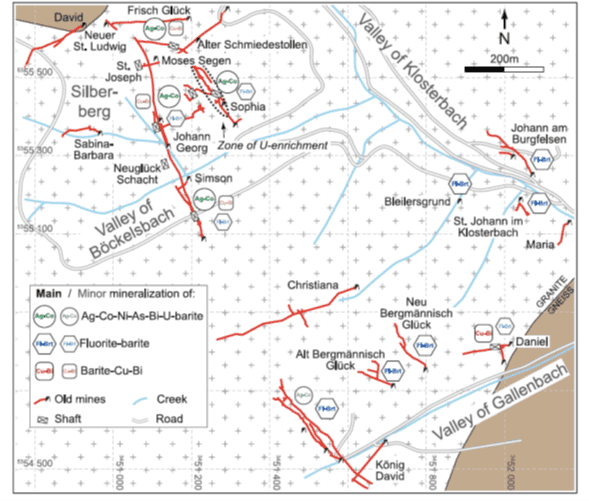
The above figure is a map of the Silberberg area in Wittichen and the valley of Gallenbach with the most important mines after Bliedtner and Martin (1986). Note that the direction of strike, which is recorded by the direction of the galleries, differs by about 20° between the fluorite/ barite-dominated veins in the south from the Ag/Co-dominated veins around the Silberberg.
The multistage mineralization formed at the intersection of two fault systems in the last 250 Ma. A Permo-Triassic ore stage I with minor U–Bi–quartz–fluorite mineralization is followed by a Jurassic to Cretaceous ore stage II with the main Ag and Co mineralization consisting of several generations of gangue minerals that host the sub-stages of U–Bi, Bi–Ag, Ni–As–Bi and Co–As–Bi.
Important ore minerals are native elements, Co and Ni arsenides, and pitchblende; sulphides are absent. The Miocene ore stage III comprises barite with the Cu–Bi sulfosalts emplectite, wittichenite and aikinite, and the sulphides anilite and djurleite besides native Bi, chalcopyrite, sphalerite, galena and tennantite.
The mineral-forming fluid system changed from low salinity (<5 wt.% NaCl) at high temperature (around 300°C) in Permian to highly saline (around
25 wt.% NaCl+CaCl ) at lower temperatures (50–150°C) in Triassic to Cretaceous times. Thermodynamic calculations and comparison with similar mineralizations worldwide show that the Mesozoic ore-forming fluid was alkaline with redox conditions above the hematite–magnetite buffer.
The authors concluded that the precipitation mechanism for native elements, pitchblende and arsenides is a decrease in pH during fluid-mixing processes.
REE patterns in fluorite and the occurrence of Bi in all stages suggest a granitic source of some ore-forming elements, whereas, e.g. Ag, Co and Ni probably have been leached from the red beds. The greater importance of Cu and isotope data indicates that the Miocene ore stage III is more influenced by fluids from the overlying red beds and limestones than the earlier mineralization stages.
In comparison to other deposits with Ag- and/or U-bearing Bi–Co–Ni mineralizations, some general conclusions can be drawn:
- Ore-forming fluids are alkaline, testified by the occurrence of calcite and native elements (e.g. Ag, Bi, As) together with hematite;
- Precipitation of pitchblende is not only caused by redox processes and changing carbonate activities but also by a pH decrease, as shown by textures of pitchblende that encloses skeletal crystals of native elements;
- The precipitation of Co–Ni arsenides around native elements probably occurs due to a pH decrease, as shown by textures similar to that of pitchblende
overgrowing native elements; and - Basic or ultrabasic rocks are not necessary prerequisites for the formation of Bi–Co–Ni mineralizations as an alkaline pH, which is produced during the diagenesis of red-bed sediments, can mobilize these elements.
Managed & Built by I2M Consulting, LLC | © 2010-
