

Mukhopadhyay and four co-authors reported in 2015 that the quartz-pebble conglomerate (QPC)-hosted detrital uranium mineralization is unique in character in terms of their restricted distribution before 2.2 Ga atmosphere during pre-Great Oxidation Event (pre-GOE). Such QPC paleoplacer deposits over the world are good targets for moderate to high tonnage and low grade uranium deposits and more importantly for their gold content.
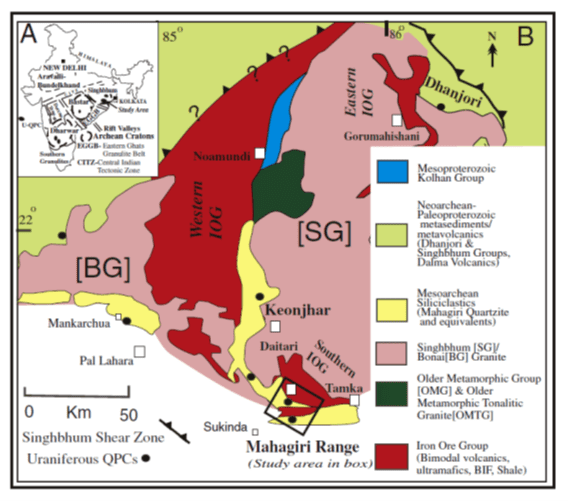
The above figure shows A) the generalized map of India with distribution of five major Archean cratonic nuclei that constitute the Indian shield. Note the occurrences of uraniferous paleoplacers in Dharwar, Bastar, and Singhbhum cratons, and B) Generalized geological map of the Singhbhum craton (modified after Saha, 1994).
The Mahagiri Quartzite, dated c. 3.02 Ga for their youngest detrital zircon population, is developed unconformably over the Mesoarchean Singhbhum Granite (3.44 Ga to 3.1 Ga). The Mahagiri Quartzite includes a conglomerate-pebbly sandstone dominated subaerial alluvial fan to coastal braided plain sequence in the lower parts and shallow marine mature quartz arenite in the upper parts. The alluvial fan-braided plain deposits in the lower parts host a number of pyritiferous and uraniferous conglomerate and pebbly sandstone beds.
The uraninite grains are rounded to subrounded in outline suggesting mechanical transport and detrital origin. Together with detrital pyrite and uraninite constitute the example of >3.0 Ga paleoplacer closely comparable to the Witwatersrand Au–U deposits. EPMA and SEM-EDS studies suggest that the uraninite grains are rich in Th (>4 wt.%), S and REE-Y.
Chemical formula calculations from EPMA analyses suggest uraninite grains belong to two populations with different oxidation states as revealed from Y/
REE and cation U4+: U6+ [apfu] ratios. The U contents of the detrital uraninite grains from Mahagiri are significantly lower than that of the ideal stoichiometric composition of UO2. This is mainly due to higher amount of heterovalent cationic substitution by Th, REE, Y, Pb, and Ca in Mahagiri QPC uraninite structures, and partial alteration and metamictization of uraninites.
Alteration due to metamictization resulted in elevated concentration of Si, Al, P, and Ca in more altered and metamict uraninite grains. The REE pattern is typically flat with comparable LREE–HREE concentration. The high Th content flat REE-pattern suggests that the uraninitere presents high temperature phases (>350°C) and are magmatic in origin. The Mahagiri detrital uraninite grains suggest existence of highly felsic and K-rich (richer than TTG) granodiorite–granite–monzogranite suites (GGM) of rocks older than 3.1 Ga in the Singhbhum craton.
Managed & Built by I2M Consulting, LLC | © 2010-
