

Izard and four co-authors reported in 2002 that primary uranium deposits (uraninite + coffinite + carbonates + “adularia” + iron sulfides) of Mina Fé, in west–central Spain, occur in fault-related rocks. These rocks have been formed by the effect of an aftershock fault cluster at the termination of a major
strike-slip fault, the Grafitosa fault.
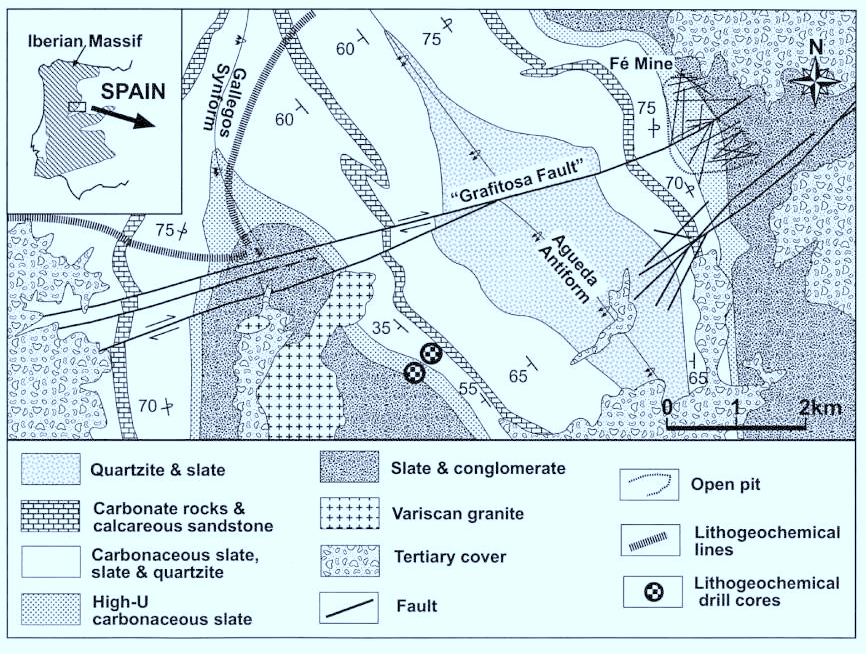
The regional geological map above of the Fé mine area illustrates the most important stratigraphic and structural features. High-U carbonaceous slates have a U content of >10 ppm.
The transpressional shear-zone termination presents two symmetrical brittle dilational jogs with reactivation of old Variscan faults and generation of other new Alpine faults. Lithogeochemical analyses show that the hydrothermal flow associated with the Grafitosa fault mobilized uranium and related elements during pressure solution in carbonaceous slates of the Variscan basement.
The orientation of the paleo-stress field in the dilational jogs, deduced from an analysis of fault populations, has shown the range of fault surfaces with favorable orientation for mineral deposition during slate consumption in the restraining bend, which agrees with a extensional setting for the ore deposit.
The detailed structural and geochemical data presented here support an Alpine age tectonic-hydrothermal model for the Fé deposit and probably other cases of uranium mineralization of the same type existing in carbonaceous metasedimentary rocks in the Iberian peninsula, most of them uncomfortably overlain by Tertiary sedimentary units.
Managed & Built by I2M Consulting, LLC | © 2010-
