

Babu and two co-authors reported in 2012 that the intracratonic Cuddapah Basin is the second largest Purana basins in Peninsular India and its northern part has shown immense potential of uranium mineralization, especially unconformity-related, with deposits established in the marginal parts of Srisailam
and Palnad Sub-basins, Nalgonda and Guntur districts, Andhra Pradesh.
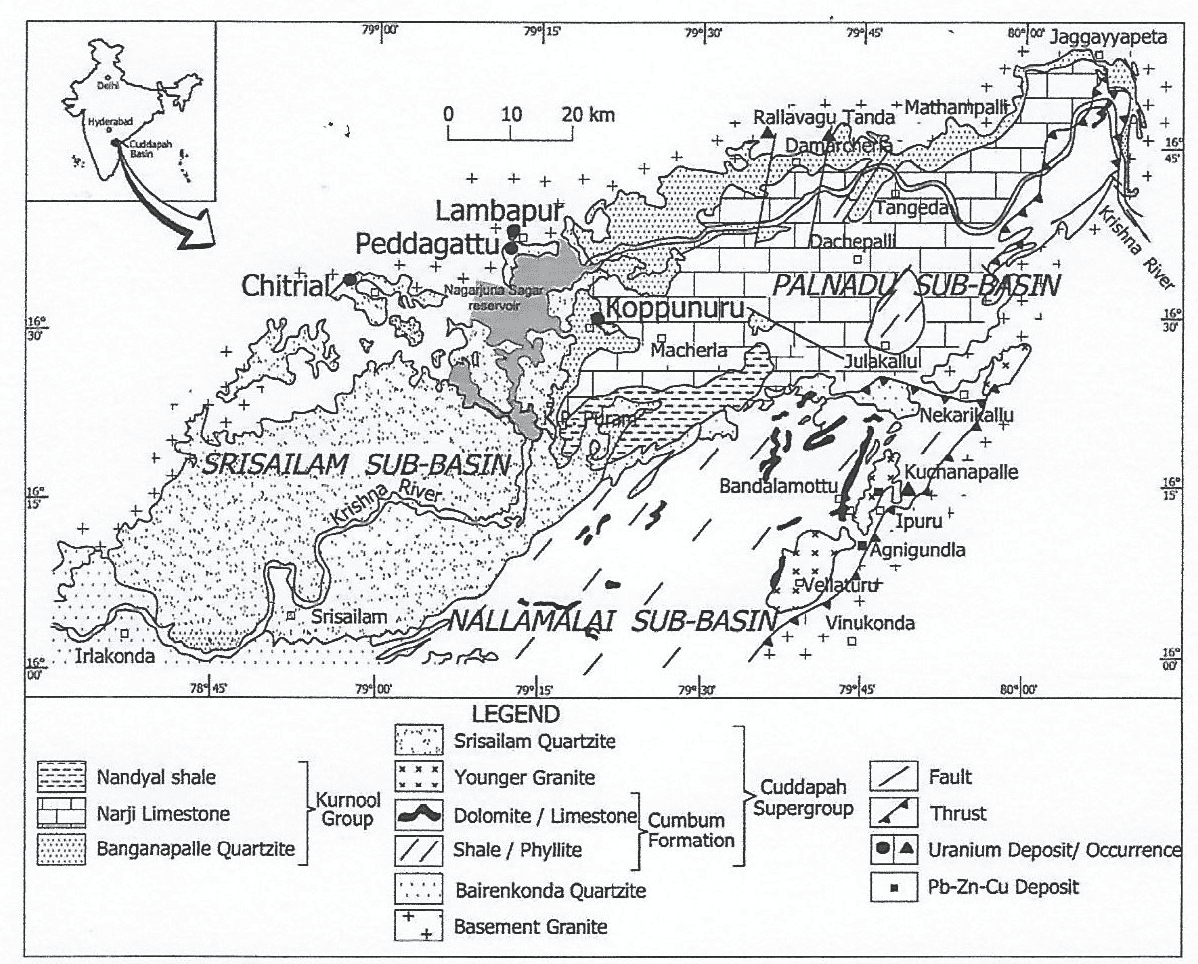
The above figure is the geological map of the northern part of the Cuddapah Basin showing disposition of Srisailam and Palnad sub-basins and location of Lambapur, Peddagattu, Chitrial and Koppunuru uranium deposits in India.
These sub-basins expose thick sedimentary columns comprising arenaceous, argillaceous and calcareous sediments of Meso- to Neoproterozoic age and are deposited predominantly over Neoarchaean to Palaeoproterozoic basement granitoids and greenstone belt of Archaean age. Signatures of substantial basement and post-depositional reactivations are quite apparent in the area represented by multiple faults, fractures and mafic and felsic intrusives. Such
geological domains provide spatial and temporal favorability for uranium metallogeny, especially when basement granitoids are fertile.
The uranium mineralization is mainly localized along fracture zones proximal to basement–cover sediment unconformity and occur as elongated pods, fine veins and cavity and grain boundary fillings. Mineralized zones are invariably associated with significant alteration features like illitization, chloritization and kaolinization.
Primary uranium ore minerals viz. pitchblende, uraninite and coffinite are found generally associated with sulphides and organic matter. However, there is marginal difference in mineralization pattern in these sub-basins as uranium is mainly hosted by granitoids just below the unconformity in Srisailam Sub-basin while it is dominantly associated with cover sediments in Palnad Sub-basin. Recent integrated surface and sub-surface studies have also indicated uranium potential in deeper parts of these subbasins.
Managed & Built by I2M Consulting, LLC | © 2010-
