

Foster and four co-authors reported in 2008 that the relations among geochemical parameters and sediment microbial communities were examined at three shoreline sites in the Prince William Sound, Alaska, which display varying degrees of impact by acid-rock drainage (ARD) associated with historic mining of volcanogenic massive sulfide deposits.
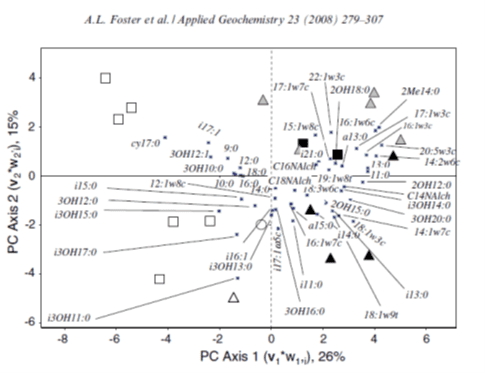
The above figure is a graphical representation of PCAs using FAMEs data. The scores (calculated by weighted averaging), of the 51 FAMEs used in the PCA are plotted (italicized words are the names of the FAMEs); the proximity of these scores to each other, to the ordination axes, and to the sample points indicates the relative importance of the FAME to the ordination.
Microbial communities were examined using total fatty acid methyl esters (FAMEs), a class of compounds derived from lipids produced by eukaryotes and prokaryotes (bacteria and Archaea); standard extraction techniques detect FAMEs from both living (viable) and dead (non-viable) biomass, but do not detect Archaeal FAMEs. Biomass and diversity (as estimated by FAMEs) varied strongly as a function of position in the tidal zone, not by study site; subtidal muds, Fe oxyhydroxide undergoing biogenic reductive dissolution, and peatrich intertidal sediment had the highest values. These estimates were lowest in acid-generating, intertidal zone sediment; if valid, the estimates suggest that only one or two bacterial species predominate in these communities, and/or that Archeal species are important members of the microbial community in this sediment.
All samples were dominated by bacterial FAMEs (median value >90%). Samples with the highest absolute abundance of eukaryotic FAMEs were biogenic Fe oxyhydroxides from shallow freshwater pools (fungi) and subtidal muds (diatoms). Eukaryotic FAMEs were practically absent from low-pH, sulfide-rich intertidal zone sediments.
The relative abundance of general microbial functional groups such as aerobes/anaerobes and gram(+)/gram(-) was not estimated due to severe inconsistency among the results obtained using several metrics reported in the literature. Principal component analyses (PCAs) were performed to investigate the relationship among samples as separate functions of water, sediment, and FAMEs data. PCAs based on water chemistry and FAMEs data resulted in similar relations among samples, whereas the PCA based on sediment chemistry produced a very different sample arrangement. Specifically, the sediment parameter PCA grouped samples with high bulk trace metal concentration regardless of whether the metals were incorporated into secondary precipitates or primary sulfides.
The water chemistry PCA and FAMEs PCA appear to be less prone to this type of artifact. Signature lipids in sulfide-rich sediments could indicate the presence of acid-tolerant and/or acidophilic members of the genus Thiobacillus or they could indicate the presence of SO4-reducing bacteria. The microbial community documented in subtidal and offshore sediments is rich in SRB and/or facultative anaerobes of the Cytophaga–Flavobacterium group; both could reasonably be expected in PWS coastal environments.
The authors concluded that the results of their study provided evidence for substantial feedback between local (meter to centimeter-scale) geochemical variations, and sediment microbial community composition, and show that microbial community signatures in the intertidal zone are significantly altered at sites where ARD drainage is present relative to sites where it is not, even if the sediment geochemistry indicates net accumulation of ARD-generated trace metals in the intertidal zone.
Managed & Built by I2M Consulting, LLC | © 2010-
