

Wolf and four co-authors reported in 2011 that An analytical method using high-performance liquid chromatography separation with inductively coupled
plasma mass spectrometry (ICP-MS) detection previously developed for the determination of Cr(III) and Cr(VI) has been adapted to allow the determination of As(III), As(V), Se(IV), Se(VI), Cr(III), and Cr(VI) under the same chromatographic conditions.
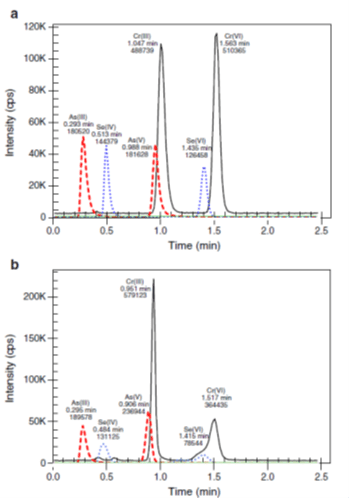 In the above figure:
A Shows a chromatogram for a 50-μg/L standard containing As(III), As(V), Cr(III), Cr(VI), Se(IV), and Se(VI) prepared in the mobile phase. Peak labels immediately adjacent to the peak indicate species identity, retention time, and integrated area counts.
B Shows the chromatograms for a 50-μg/L analytical spike in reference water sample M-172.
The solid black line is the chromatogram for 52Cr. The dotted blue line is the chromatogram for 78Se. The dashed red line is the chromatogram for 75As
Using this method, all six inorganic species can be determined in less than 3 min. A dynamic reaction cell (DRC)–ICP-MS system was used to detect the species eluted from the chromatographic column in order to reduce interferences. A variety of reaction cell gases and conditions may be utilized with the DRC–ICPMS, and final selection of conditions is determined by data quality objectives. Results indicated all starting standards, reagents, and sample vials should be thoroughly tested for contamination.
Tests on species stability indicated that refrigeration at 10°C was preferential to freezing for most species, particularly when all species were present, and that sample solutions and extracts should be analyzed as soon as possible to eliminate species instability and interconversion effects.
A variety of environmental and geological samples, including waters and deionized water [leachates] and simulated biological leachates from soils and wildfire ashes have been analyzed using this method. Analytical spikes performed on each sample were used to evaluate data quality. Speciation analyses were conducted on deionized water leachates and simulated lung fluid leachates of ash and soils impacted by wildfires. These results show that, for leachates containing high levels of total Cr, the majority of the chromium was present in the hexavalent Cr(VI) form.
In general, total and hexavalent chromium levels for samples taken from burned residential areas were higher than those obtained from nonresidential
forested areas. Arsenic, when found, was generally in the more oxidized As(V) form. Selenium (IV) and (VI) were present, but typically at low levels.
Managed & Built by I2M Consulting, LLC | © 2010-
