

Thomas and seven co-authors reported in 2014 that unconformity-related uranium mineralization occurs in Banganapalle Formation of Palnad Sub-basin, Cuddapah Basin. Several evidences of hydrothermal activity exist in both basement granite and the overlying sediments in Koppunuru and Rallavagu Tanda (R.V. Tanda) uranium prospects of Palnad Sub-basin.
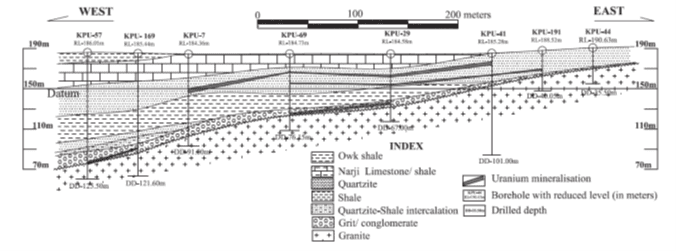 Borehole correlation section of uranium deposit in Koppunuru prospect
(Ramesh Babu et al., 2012).
Profuse development of fracture-filled veins consisting of epidote–quartz, chlorite–quartz and quartz is observed at various depths above and below unconformity. Fluid–rock interaction during the formation of these veins has resulted in the alteration of feldspars and mafic minerals of granite and arkosic quartzite into a mineral assemblage consisting of various proportion of illite, chlorite, muscovite and pyrite, with the intensity of alterations being highest near to the unconformity. Pyrite is often associated with illite dominant alteration zone.
The authors concluded that circulation of basinal brine through basement granite and cover sediments was responsible for mobilizing uranium from granite and its precipitation at favorable locations in cover sediments. Increase in pH of ore fluid due to illitization and chloritization of wallrock together with availability of carbonaceous matter and pyrite as reductant have controlled the localization of uranium mineralization in Banganapalle Formation.
Managed & Built by I2M Consulting, LLC | © 2010-
