

Gupta and four co-authors reported in 2016 that the Banganapalle Formation is the lowermost member of the Neoproterozoic Kurnool Group, which is underlain by the Neoarchaean biotite granite in the western part of the Palnad sub-basin of the Cuddapah Basin. The Banganapalle sediments are represented by 10–173 meter thick sequence of basal conglomerate/grit and quartzites, with shale intercalations in the Koppunuru– Chenchu colony area, Guntur district, Andhra Pradesh.
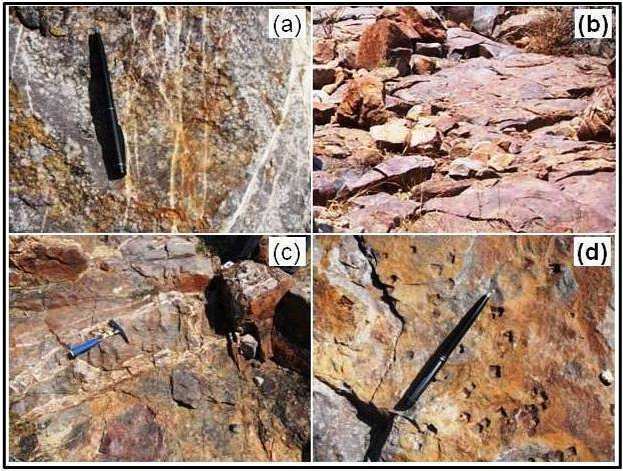
The above figure shows field photographs of the different features associated with Banganapalle Quartzites of Chenchu colony and adjoining areas:
a) Gritty quartzite showing close spaced thin quartz veins;
b) Profuse fracturing/jointing in quartzites with reddish brown colour at top surface;
c) Quartz veins and fractures in quartzite signifying post-depositional reactivation; and
d) Cubic vugs created by leaching of pyrite.
Significant uranium occurrences (up to 0.035% U3O8; <0.005% ThO2) hosted by the Banganapalle quartzite have been delineated in the area south of the Chenchu colony, which indicates disequilibrium of uranium in favor of the parent (U3O8(b/g) : U3O8(Rae) = 1.05–1.39). The mineralized zones follow the NNW–SSE trending major structural grain of the area signifying their fracture controlled nature. Uranium mainly occurs as fine veinlets of pitchblende within chlorite, as globular patches of urano-organic complex in intergranular spaces, and in adsorbed state in clay, chlorite and iron oxides in the host rock, suggesting epigenetic nature of mineralization.
These mineralized siliciclastic rocks show major quartz clast-supported texture, siliceous cement, minor clay/chlorite matrix and negligible lithic fragments, and exhibit high textural and chemical maturity. Based on petromineralogical and geochemical characters, these are classified as quartz arenite.
Discriminant function analysis using major oxides indicates distinct quartzose sedimentary provenance, which is further substantiated by the presence of older siliciclastic rocks of the Cuddapah Supergroup to the west and north of the present study area. Furthermore, basement granitoids of adjoining areas have also contributed silica dominant clastic sediments to the system.
Managed & Built by I2M Consulting, LLC | © 2010-
