

Adlakha and five co-authors reported in 2015 on their documentation of the occurrence and chemical variation of hydrothermal alteration minerals along the P2 fault, the structural host for the world-class McArthur River uranium deposit in order to identify the mineralogical footprint of ore-forming fluids, define exploration criteria for fertile basement structures associated with this deposit type and infer the nature of the fluids.
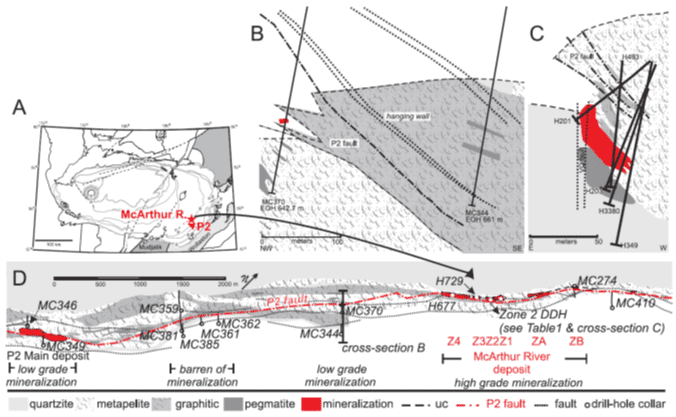
in summary, the above figure shows:
A) A simplified map of the Athabasca Basin showing location of the P2 fault and McArthur River deposit (modified from Jefferson et al., 2007).
B) A schematic cross-section showing an example of a drill hole that intersected the P2 fault proximal to low-grade mineralization (DDH MC370) and a
“background” drill hole that did not intersect the P2 fault (DDH MC344).
C) A cross-section of the Zone 2 basement hosted orebody showing sampled drill core which intersect the orebody and/or the alteration halo.
D) An interpreted geological strip map at the unconformity showing the P2 fault, the locations of sampled drill holes (italicized MC### or H###), ore bodies and the sites of the cross sections (B) and (C). Low-grade mineralization occurs along the middle and southeast (P2 Main deposit) portions of the P2 fault. The P2 fault is essentially barren in the southwestern part. Z1–4 = Zone numbers of orebody at the McArthur River deposit; uc = unconformity.
The cross-sections (A) and (B) plan view map (D) and were modified from Cameco internal reports.
An assemblage of florencite (LREE-rich aluminum phosphate-sulphate; APS) and magnesio-foitite (alkali deficient Mg tourmaline) with sudoite and illite formed in the basement rocks along the P2 fault and is distinct relative to the alteration assemblages that formed in the basement rocks outside the fault.
This assemblage occurs along the entire P2 fault, regardless of its proximity to the McArthur River uranium deposit and is interpreted to be the mineralogical footprint of ore-forming fluids. It may be useful when targeting fertile basement faults during exploration. Compositional zoning in APS minerals indicate that earlier fluids were SO42--rich and became P and LREE-rich through interactions with the basement rocks.
The chemical composition of florencite and magnesio-foitite indicates that mineralizing fluids contained low Na and were enriched in REE, especially in the ore zone. High δ11B values in magnesio-foitite are interpreted as being sourced from B dissolution by fluids from evaporitic rocks.
The authors concluded that the similar chemistry and occurrence of these minerals along the entire P2 fault, regardless of proximity to ore, indicate that the P2 fault was a conduit for mineralizing fluids and that the precipitation of uranium was selective to the location of the McArthur River deposit.
Managed & Built by I2M Consulting, LLC | © 2010-
