

Alexandre and six co-authors reported in 2015 that the Matoush uranium deposit is situated in the Paleoproterozoic Otish Basin, northern Quebec, Canada, and is hosted by the Indicator Formation sandstones. Its sheet-like ore bodies are closely associated with the steeply dipping Matoush Fracture, which hosts mafic dykes and minor quartz–feldspar–tourmaline pegmatites.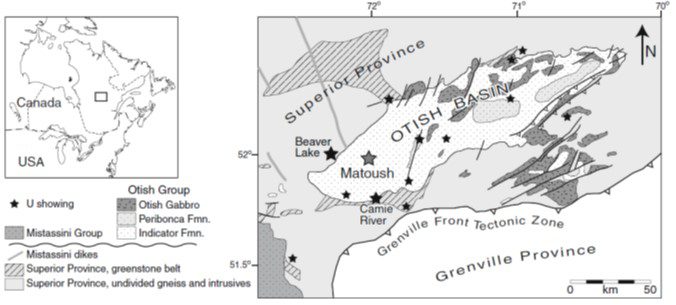 Simplified geological map of the Otish Basin, Quebec, showing the location
of the Matoush deposit and other uranium showings.
Modified from Chown and Caty (1973, 1983) and Gatzweiler (1987)
Regional diagenesis, involving oxidizing basinal fluids (δ2H ~−15‰, δ18O ~8‰), produced mostly illite and possibly leached U from accessory phases in the Indicator Formation sandstones. The bimodal Matoush dyke intruded the Indicator Formation along the Matoush Fracture, and the related metasomatism produced Cr-rich dravite and muscovite in both the dyke and the proximal sandstones. Uraninite formed when U6+ in the basinal brine was reduced to U4+ in contact with the mafic dyke and by Fe2+ in Cr–dravite and Cr–muscovite, and precipitated together with eskolaite and hematite.
Because of its unique characteristics, the Matoush deposit cannot be easily classified within the generally accepted classification of uranium deposits. Two of its main characteristics (unusual reduction mechanism, structural control) do not correspond to the sandstone-hosted group of deposits (unconformity type, tabular, roll front), in spite of uranium being derived from the Otish Group sandstones.
Managed & Built by I2M Consulting, LLC | © 2010-
