

Alexandre and Kyser reported in 2005 that uraninite grains from two sites of unconformity-type uranium mineralization, the high-grade basement-hosted McArthur River deposit and the sediment-hosted Virgin River prospect in the Paleoproterozoic Athabasca Basin in northern Saskatchewan, Canada, were investigated with a scanning electron microscope and analyzed with an electron microprobe.
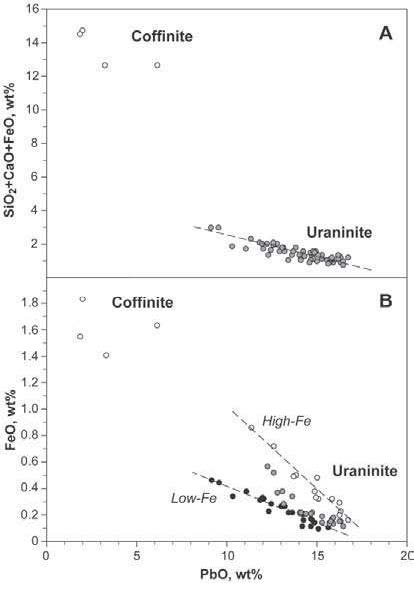 As illustrated in the above figure, the compositional variation of uraninite from the basement-hosted McArthur River deposit shows negative correlation between SiO2 + CaO + FeO and PbO (A) and between FeO and PbO (B). The composition of coffinite (white circles) is distinct (A). The negative correlation
between FeO and PbO contents (B) can be divided into high-iron (light grey circles) and low-iron trends (black circles).
Electron back-scatter images, chemical compositions and calculated chemical U/Pb ages from the uraninite indicate substitution of radiogenic Pb by Ca, Si, and Fe from later fluid-circulation events after initial formation of the uraninite at ca. 1600 Ma. Conversion of uraninite to coffinite,with SiO2 up to 10 wt%, seems to have occurred at ca. 700 Ma. The intensity and the character of the substitutions depend on both the amount and the composition of the alteration fluids, which may be influenced by the characteristics of the host rocks.
The authors concluded that electron-microprobe analyses do indicate that uraninite readily exchanges elements with the later fluids. In particular, radiogenic Pb is replaced by Ca, Si, and Fe (Janeczek & Ewing 1992b) via discrete alteration of uraninite. The most significant substitution leads to conversion of uraninite to coffinite, with up to 10 wt% SiO2. The character of the substitutions depends on the amount and composition of the alteration fluids, particularly their capacity for oxidation.
Many of the chemical factors are influenced, to a certain degree, by the characteristics of the host rocks. Calculated chemical U–Pb ages are much younger
than those obtained by isotopic dating, as Pb leaves the uraninite. The chemical U–Pb ages should thus be used with caution, and in all cases, in conjunction with the chemical composition of the uraninite.
Regression of the concentrations of the substituting element can indicate initial ages of crystallization in some cases.
Managed & Built by I2M Consulting, LLC | © 2010-
