

Liu reported in 2014 that uranium was discovered in 1789, first isolated and found radioactive in 1896 by Henri Becquerel. Since mid-1950s, uranium has been the source for nuclear energy, which is more efficient than traditional energy and does not produce greenhouse gases. Being the most important source of naturally occurring uranium, uranium ore was first found near the Port Radium in Saskatchewan, Canada, and the exploration began in 1942 in response to the military demand.
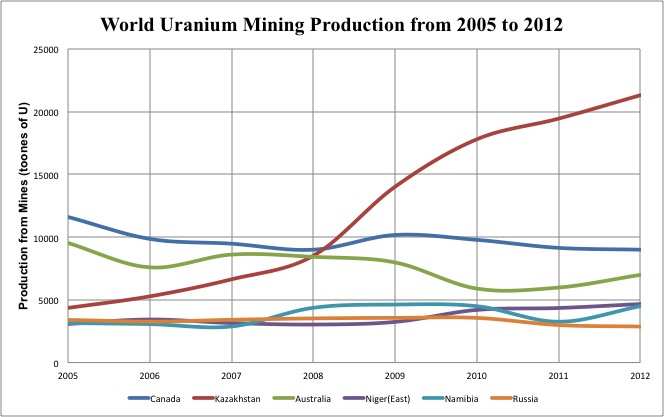 World uranium production from 2005-2012, data retrieved from
World Nuclear Association.
Although uranium deposits are found in many countries, more than a half of uranium production is concentrated in Canada, Australia, Kazakhstan and Africa (Stevens, 2012). Among theses districts, Canada has been the world’s largest uranium producer for years until in 2009 replaced by Kazakhstan, and it is estimated that Canada has contributed to 22% of the world uranium output (World Nuclear Association, 2014, Figure 1).
There are many types of uranium deposits, but the major type is unconformity-associated, which means that the deposits are located near the major unconformity that separates two rock masses at the base of a sedimentary basin. Most of the uranium deposits, regardless of their types, are low to moderate grade (Stevens, 2012), but the unconformity deposits of Athabasca Basin (Figure 2.) is typical of high grade (Jefferson et al., 2007).
The essay will be focused on McArthur River Uranium Mine in Athabasca Basin in Canada, which is claimed to be the world’s largest high-grade mine. The McArthur River Uranium Mine is located about 620 kilometers north of Saskatoon, Saskatchewan. Located underground for about 600m, the uranium reserves is enormous (192,085 tonnes of U) at an anomalous high grade (22.8%). The production of uranium on this site was initiated by Cameco Corporation in 1999, and has accumulated to 211 million pounds of U3O8 until 2012 (Cameco Corporation, 2012).
Managed & Built by I2M Consulting, LLC | © 2010-
