

Mckechnie reported in her outstanding master's degree thesis reported in 2012 that the Fraser Lakes Zone B U-Th-LREE deposit is located approximately 50 km SE of the Key Lake uranium mine in the Wollaston Domain of Northern Saskatchewan, Canada.
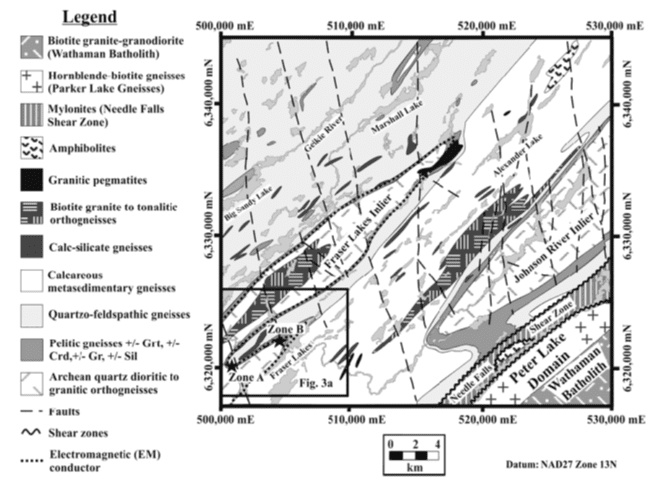 The above geological map covers the Fraser Lakes and surrounding area, modified from Ray (1980). Box shows the location of Figure 2-3a. Here, a number of variably radioactive pegmatites and leucogranites intruded the highly sheared, unconformable contact between Paleoproterozoic Wollaston Group metasedimentary rocks and the underlying Archean orthogneisses, in a NNE-plunging antiformal fold nose.
The U-Th-LREE mineralized pegmatites were subdivided into two groups based on their mineralogical and spatial differences. Both groups contain variable amounts of quartz, K-feldspar, plagioclase, biotite, magnetite, and ilmenite. The Group A pegmatites, in the eastern part of the fold nose, contain small amounts of uraninite, uranoan thorite, zircon, and rare coffinite and allanite, and are typically U- ±Th-enriched (Th/U ~1). The Group B pegmatites, in
the central part of the fold nose, are Th- and LREE- enriched (Th/U up to ~20) and contain small amounts of monazite, uranoan thorite, and zircon, with rare allanite and pyrochlore-group minerals.
The Group A pegmatites are interpreted to represent slightly more evolved crust melts that underwent higher degrees of restite unmixing, whereas the Group B pegmatites are postulated to have resulted from partial melting and incorporation of more restitic and peritectic material. Field relationships and chemical age dating of the pegmatites suggests that they formed between 1.85 to 1.80 Ga, during peak thermal metamorphism and ensuing decompression related to the ca. 1.9 to 1.8 Ga Trans-Hudson Orogen (THO).
Examination of the pelitic gneiss host rocks at Fraser Lakes Zone B revealed that the area underwent high temperature (up to ~780°- 800° C), low to medium pressure (max pressures of ~7-8 kbar), upper amphibolite to granulite facies metamorphism (accompanied by partial melting), followed by isothermal decompression (down to ~3 kbar) at approximately 1.81-1.80 Ga. After this, the rocks began to cool and retrograde metamorphism took place at amphibolite to greenschist facies. Later faulting and hydrothermal fluid flow served to alter the pegmatites and led to local remobilization of U and
other metals in fractures and faults.
The pegmatite-forming melts are interpreted to have formed by partial melting (via biotite-dehydration reactions) of U-, Th- and REE-enriched rocks similar to the Wollaston Group at depth. The melts migrated upwards to the emplacement level within and along major structural zones, including sheared fold limbs, metamorphic foliations, and the deformed Archean/Paleoproterozoic contact. The melt was concentrated in antiformal fold noses and other dilational zones, where it crystallized to form the pegmatite and leucogranite bodies.
The style of mineralization and the structural control is similar to other pegmatite-hosted uranium deposits, including the Rössing alaskite-hosted deposit in Namibia. The knowledge gained from this study can be applied to exploration for similar deposits in northern Saskatchewan and other areas with similar geology.
Implications for uranium exploration
The main goal of her study was to determine the controls on the mineralization in order to aid exploration for similar deposits in the Fraser Lakes area. A number of criteria are introduced below to help achieve this aim:
1. Area experienced high grade metamorphism of at least upper amphibolite to lower granulite-facies, enough to cause significant partial melting via biotite-dehydration melting reactions;
2. Area contained fertile lithologies, i.e. those capable of partially melting. Metasedimentary rocks are particularly fertile as they contain abundant micas capable of undergoing dehydration reactions;
3. Source of the partial melt was enriched in uranium, thorium, and rare-earth elements, in particular in minerals that were in contact with significant amounts of melt; allowing for greater dissolution of these minerals thus concentrating the melts in U, Th, and REE;
4. There is an association with dilational areas, in particular fold noses like the antiformal fold nose at Fraser Lakes Zone B, as melt would concentrate in these areas;
5. Shear zones provide good conduits for melt transport from lower in the crust, especially where there is a lithological and thus a rheological contrast in the rocks;
6. There is an association with the Wollaston Group – Archean orthogneiss unconformity – this is due to structural (this contact is often highly sheared) as well as geochemical constraints (graphitic pelitic gneisses, which are almost highly sheared and form a source of uranium and additionally can be a reducing agent for uranium, are common at this boundary and can exert a geochemical control on the mineralization- see next point);
7. In particular, there is an association with the margins of the pegmatites – this is believed to be due to redox controls and assimilation as any change in the chemistry of the melt may affect the solubility of U, Th, and REEs in the pegmatites (and thus lead to crystallization of U-Th-REE-rich minerals);
8. Late hydrothermal fluids can serve to convert the uranium into a more accessible form (i.e. secondary uranium oxides amenable to current leaching methods), but can also destroy the mineralization. Thus, the rocks must be looked at in detail to make sure they have not lost significant uranium to fluids;
9. The mineralogy of these pegmatites must be carefully examined to make sure it is conducive to leaching by current methods – uraninite is good, but if the uranium is locked up within Nb-Ti-oxides or other refractory minerals, then it is much harder to extract the uranium. Thus, the mineralogy can render a deposit uneconomic and should be examined shortly after discovery;
10. There is an association of these rocks with unconformity-related uranium deposits, though the exact role they play is highly debated – U-rich pegmatites have been postulated to be the source of uranium for these deposits in a number of ways (see Chapter 2 and Appendix L for further discussion);
11. The highest grades are in association with biotite- and/or quartz-rich portions of the pegmatites – the biotite association may be due to the U-Th-REE-rich minerals forming inclusions in xenocrystic biotite (this is especially true for monazite). The association with quartz-rich rocks is harder to describe, but may be due to uranium being concentrated in the residual fluid stage following the majority of crystallization of the pegmatites (Parslow and Thomas 1982);
12. The Th-rich pegmatites are interpreted to be closer to their source areas and have undergone less restite-unmixing, and are more residual in composition relative to the U-rich pegmatites – while at Fraser Lakes there is a fault separating the two areas of mineralization form each other, it is not known if this fault has juxtaposed two different levels of the crust (thus why we see the two groups of pegmatites) or if the spatial differences are just due to differences in age, melt transport paths, and source composition. Further work on the Group B pegmatites would be required to determine their exact age and thus, their relationship to metamorphism and intrusion of the Group B pegmatites.
Managed & Built by I2M Consulting, LLC | © 2010-
