

Annesley and four co-authors reported in 2010 that the Fraser Lakes uranium and thorium showings are located immediately southeast of the Athabasca Basin, Saskatchewan.
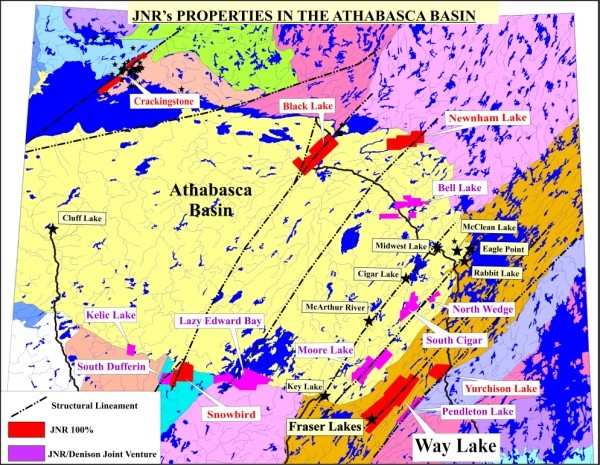
The figure above illustrates the geological subdivisions of northern Saskatchewan, with the location of important uranium deposits, and JNR Resources Inc. properties, including Way Lake (JNR Resources Inc., 2009) The mineralized granitic pegmatites/leucogranites occur within the contact zone between Wollaston Group metasediments and underlying Archean orthogneisses, and are interpreted to outcrop ~200m below the eroded, uplifted paleo-unconformity with overlying Athabasca Group sandstones. They are composed mainly of quartz, feldspars, and biotite, with subordinate amounts of apatite, monazite, allanite, U-rich zircon, uraninite- uranothorite-thorite, and ilmenite.
Some uraninite grains are zoned. Uraninite alteration is greatest along grain boundaries and fractures with significant U loss and Pb gain/loss. U-Th-Pb chemical age dating of the uraninite grains yielded a crystallization age of 1770 ±90 Ma (i.e. the pegmatite age) and some younger age clusters. These younger ages correlate to U-mineralization events documented for unconformity-type uranium deposits in the Athabasca Basin. Post-Athabasca alteration of these granitic pegmatites may have provided some additional U for unconformity-type uranium mineralization.
Managed & Built by I2M Consulting, LLC | © 2010-
