

Chen and three co-authors reported in 2015 that to evaluate the relationship between the enrichment of REEs and U mineralization, they conducted a Principal Component Analysis (PCA) of sandstones above the Phoenix U deposits and in the REE-rich Maw Zone in the eastern Athabasca Basin.
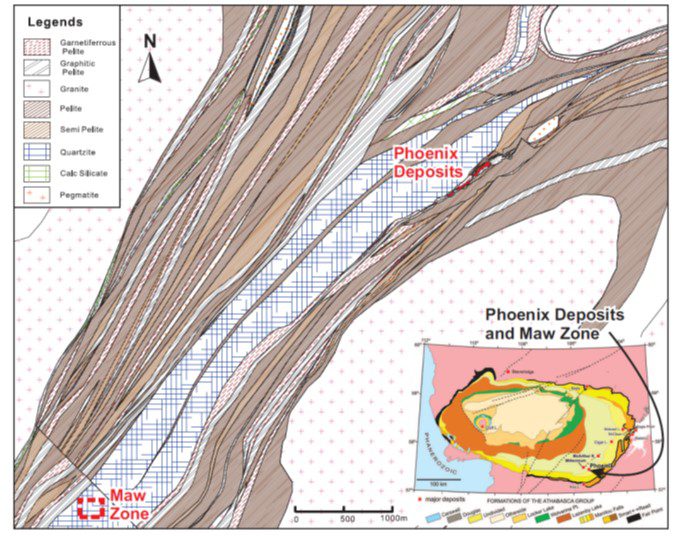
The figure above is a basement geological map of the Wheeler River Property illustrating the location of the Maw Zone 4 km southwest of the Phoenix Deposit Zone B (Denison Mines Corp., 2014). Inset: Location of the study area within the Athabasca Basin, northern Saskatchewan (after Jefferson et al., 2007).
The Phoenix deposits, with indicated resources of 70.2 M lbs U3O8, occur along the unconformity and a steeply dipping fault in the basement at ca. 400 m depth. The MAW Zone, a breccia pipe with surface exposure of 300 by 200 m, consists of highly silicified, hematitized, dravitic tourmaline-rich rocks with high REE (<8.1 wt. % as total REE oxides). The Maw Zone is ca. 4 km southwest from the south end of Phoenix deposits and does not contain high U (< 7.8 ppm U) contents. PCA of sandstones above the Phoenix deposits shows that U is associated with Heavy REEs (HREE)+Y, Light REEs (LREE) and Pb, and inversely correlated with Ti, Zr, Al, and Th.
The MAW Zone displays different element groupings as revealed by PCA: U is strongly correlated with V, Cr, Fe, Ni, Cu, Cd, Na, Li and Ba, but very weakly correlated with HREEs+Y, and inversely with LREEs and P. Relative enrichment of HREEs, Y, and P suggests xenotime is the predominant host of the HREEs. The grouping of LREEs+Sr+Th+P suggests the occurrence of monazite and/or aluminum phosphate-sulphate (APS) minerals.
A mineralogical study confirmed xenotime and APS minerals as the major host of HREEs and LREEs, respectively. These REE-bearing minerals precipitated from hydrothermal fluids during the brecciation of hematitized sandstones. The positive association between U and Fe in the PCA plot from the Maw Zone suggests that U was transported by oxidized fluids. The absence of U mineralization in the Maw Zone is explained by low U in the oxidizing fluids, or a lack reducing fluids to precipitate U.
Managed & Built by I2M Consulting, LLC | © 2010-
