

Maiga and 4 co-authors reported in 2023 that in today’s race to find ways to produce cheap and green hydrogen, the natural hydrogen wells in Bourakebougou offer a promising solution and are a good example of how H2 can be produced in the natural environment.
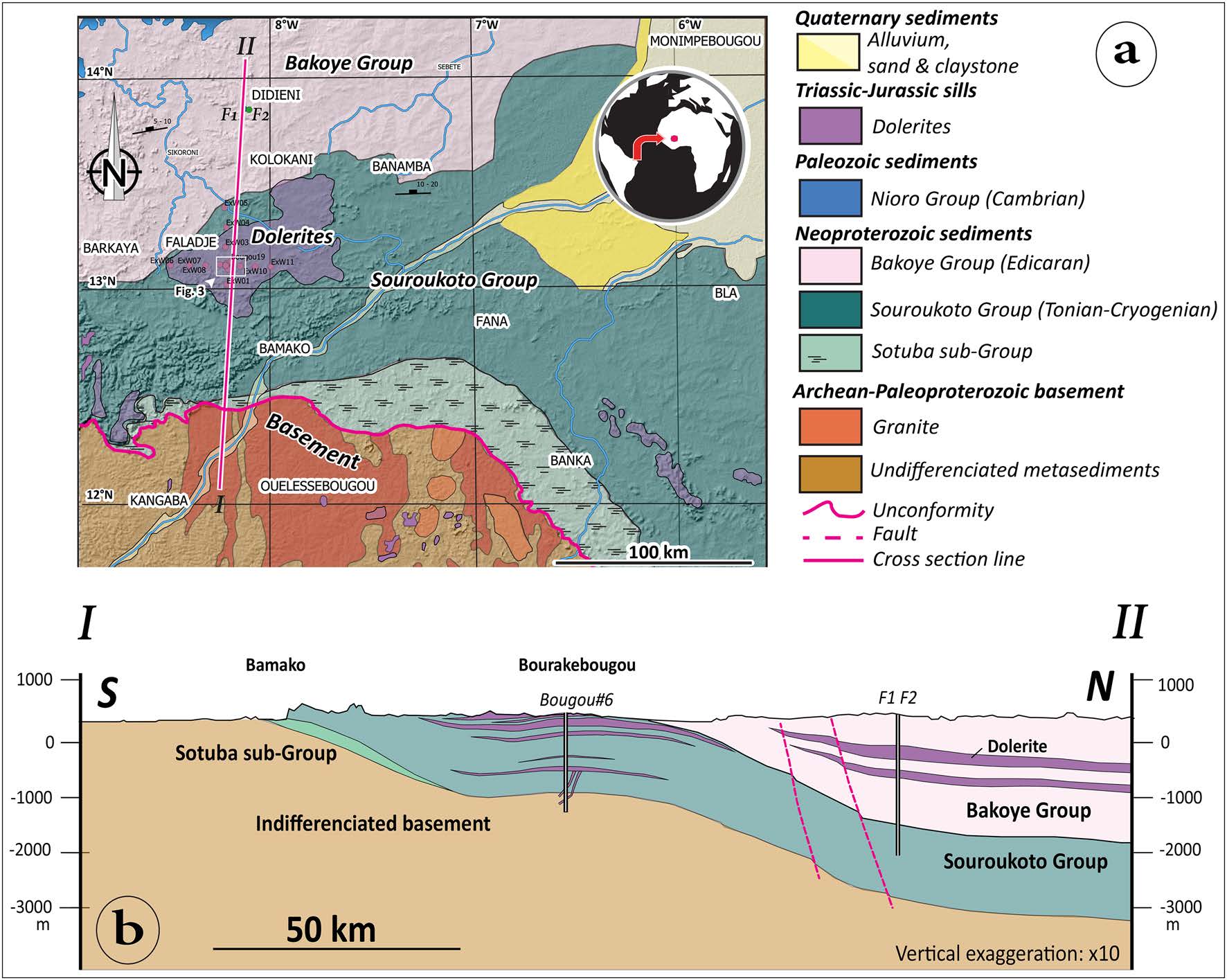
In the above figure, (a) a geological map of the study area was designed and modified from the Global Geological Map of Mali (1/1 500 000), DNGM29, (b) Synthetic and simplified structural section of the study made according to the cross section line in (a).
Not only has one well been successfully exploited to generate electricity for the local village, but twenty-four other exploratory boreholes have also demonstrated the presence of natural H2 in the surrounding area.
The Bourakebougou H2 field offers a unique opportunity for geoscientists to determine the key characteristics of natural hydrogen reservoirs. This paper presents the coring, logging, and geochemistry studies that were performed to better characterize the nature of the Bourakebougou H2-bearing reservoirs. The shallowest main reservoir, in which there is the highest content of H2, is made of dolomitic carbonate (Neoproterozoic cap carbonate). These carbonates are largely karstified and show a high degree of heterogeneity in porosity (0.21–14.32%).
Based on the analysis of the drilling imagery of the carbonated reservoirs, the accumulation of hydrogen occurs in the karst (void) representing a secondary porosity in the rock matrix. Other reservoirs, especially the deepest ones, are porous sandstone rocks with much more homogeneous porosities (4.52- 6.37%) compared to the massive carbonates. For the wells analysed, the neutron tool reacted in a specific way when there is the presence of hydrogen. Hence, it stands out as being the primary tool to detect the presence of natural hydrogen beyond simple gas logging. When comparing a H2 reservoir system to classical oil and gas reservoir systems, the results show that the hydrogen reservoir is a dynamic system that is progressively recharged in H2-rich gas at the production timescale.
Over the past decade, natural hydrogen exploration has increased significantly on all continents. The Bourakebougou field is the most advanced case with the most significant data available. In production since 2012 to supply electricity to the village of Bourakebougou, the site is an emblematic example of an accumulation of natural hydrogen in an intracratonic continental context. It has therefore become important to use this case study to better understand what a natural hydrogen reservoir system is and to provide guidelines for further exploration.
The Bourakebougou natural hydrogen in Mali was discovered during a water drilling operation in 1987. Since then, 24 other boreholes drilled by Hydroma (most of them at shallow depths) have discovered H2 accumulations as shallow as 100 m in several carbonate reservoirs covered by dolerite sills. One of the 25 boreholes reached the basement and other deeper reservoirs have been identified within the Neoproterozoic sedimentary cover.
Gas Chromatography analysis of the gas phase in the shallower main reservoir has shown that the gas is mainly composed of natural H2 (98%) associated with nitrogen and methane (1% each). Gas logging has also shown a very high H2/CH4 ratio with generally higher values in the upper part of each individual reservoir.
The noble gases associated with this H2-rich gas have crustal signatures. Old cratons and regions with iron-rich formations, especially the Neoproterozoic formations, are potentially prone for natural hydrogen generation. In the case of the Bourakebougou field, Briere and Jerzykiewicz discussed seven theories of H2 generation, but oxidation of FeII-rich rocks associated to water reduction is assumed to be the main origin of H2.
Today, whereas the presence of natural H2 appears to be increasingly common in the form of surface seepages, in particular on the continents but also in different geological contexts such as hydrothermal systems in mid-oceanic ridges and ophiolites, we still do not know exactly what a natural hydrogen reservoir is and whether it can be compared with classical oil and gas reservoirs. The question that remains is what are the typical geological characteristics of an exploitable H2 reservoir?
The objective of this study was to try to fill this knowledge gap. To do so, a detailed characterization of the H2-bearing reservoirs, using geological, mineralogical, and logging data was performed. This allowed us to better define the reservoirs’ properties, to better understand the accumulation process of H2 in the reservoirs, and to know what is the most efficient tool to characterize the presence of hydrogen, apart from a simple gas logging. The results obtained can be used as a reference to search for similar sites worldwide and to potentially identify target reservoirs for future productions.
Managed & Built by I2M Consulting, LLC | © 2010-
