

Saller reported in early 2018 that understanding subsurface waters is important for hydrocarbon exploration and development. Groundwater samples from the Permian Basin were collected and analyzed for stable isotopes, ionic concentrations, and strontium isotopes to determine their origin. Three main geochemical groups of waters are present.
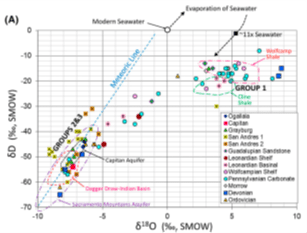
The above plot obviously involves δ18O versus δD for water samples. Blue dashed line is the meteoric precipitation line from Craig (1961). Data for meteoric waters from the Sacramento Mountains aquifer are from Eastoe and Rodney (2014). Black dashed line and arrows show the trajectory of highly evaporated seawater from Holser (1979).
Data for waters from the Wolfcamp and Cline shales are from Engle et al. (2016). Dagger Draw and Indian Basin water data are from Pennsylvanian carbonates reported by Barnaby et al. (2004). Capitan aquifer data are from Lambert and Harvey (1987). Group 1 waters have d18O values that cluster from +2‰ to +9‰ SMOW (standard mean ocean water), and dD values cluster from -12‰ to -24‰ SMOW. Groups 2 and 3 have d18O values of -5‰ to -10‰ SMOW, and dD values of -30‰ to -70‰ SMOW. San Andres 2 samples have high salinity (>150 g/L) and low d18O.
San Andres 1 samples represent the remainder of the San Andres samples. Group 1 has high d18O and dD values with high total dissolved solids (TDS; 100–240 g/L), including high concentrations of Na+, Cl-, and Br-. Group 1 groundwater contain distinctly less sodium (Na+) thanc hlorine (Cl-) on a molar basis, similar to modern seawater. Group 2 and 3 waters have low d18O and dD values. Group 2 waters have relatively low TDS (4–75 g/L). Group 3 waters have high TDS (170–225 g/L), Na+ and Cl- in approximately equal molar amounts, and low Br- concentrations.
Group 1 waters are interpreted as forming from highly evaporated seawater during precipitation of uppermost Permian salts. Because of their high density, those waters displaced preexisting formation waters throughout the Permian Basin during the latest Permian. Waters in groups 2 and 3 came mainly from precipitation in the mountains of southeast New Mexico. Those mountains formed during Neogene tectonic uplifts. Group 3 waters acquired their Na+ and
Cl- by dissolution of upper Permian salt. Many group 2 and 3 waters acquired their Ca2+ and SO4 2- by dissolution of Permian anhydrite or gypsum.
Some groundwater contained a mixture of these groups. Understanding the origin of groundwater helps predict subsurface salinity, aquifer drive, sulfate reduction, chemical reactions during water injection, and chemistry of diagenetic waters.
Managed & Built by I2M Consulting, LLC | © 2010-
