

Hiatt and three co-authors reported in 2010 that the Paleoproterozoic (Statherian) Thelon Basin is located in the Churchill Province of the Canadian Shield, formed following the Trans-Hudson Orogeny Basin formation followed an interval of felsic volcanism and weathering of underlying bedrock.The diagenetic evolution of the Thelon lasted about one billion years and was punctuated by fluid movement influenced by tectonic events.
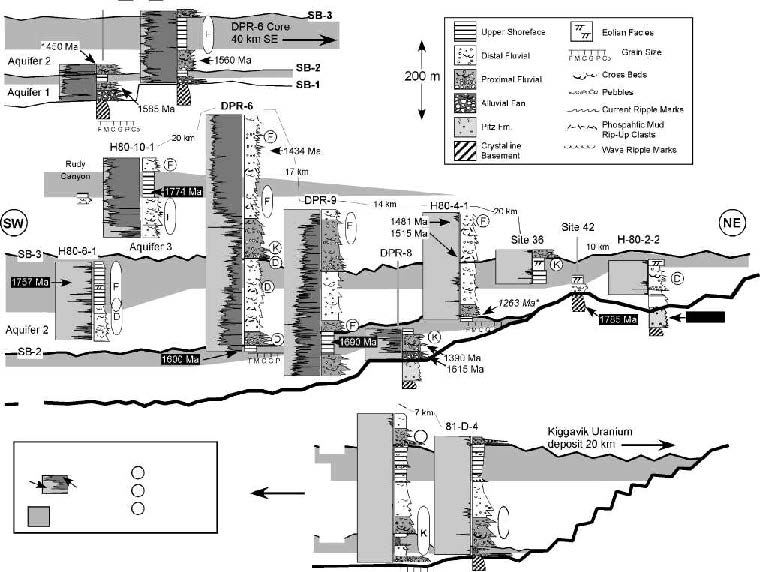
In the above figure, stratigraphic sections are included in this study showing distribution of major diagenetic phases and their relation to lithology, sequence and hydrostratigraphy and stratigraphy. Relative clay abundance normalized to 100% is shown in shaded columns to the left of stratigraphic logs. Ar/Ar ages of illite are shown in the stratigraphic position of where samples were collected. Dates with white lettering on black background represent those collected from diagenetic aquitards, and those with black lettering are from diagenetic aquifers. The 1263 Ma date from near the base of core H80-4-1 is from a sample on the unconformity. SB, sequence boundary; K, kaolinite (diagenetic stage 1); F,K-feldspar cement (diagenetic stage 4); and D, dolomite cement (diagenetic stage 5).
Early quartz cements formed in well-sorted, quartz-rich facies during diagenetic stage 1; Fluids in which these overgrowths formed had δ18O values near 0% (Vienna Standard Mean Ocean Water). Uranium-rich apatite cement (P1) also formed during diagenetic stage 1 indicating that oxygenated, uranium-bearing groundwater was present in the basin early in its diagenetic history. Syntaxial quartz cement (Q1) formed in groundwater with δ18O from -4 to -0.8% in diagenetic stage 2. Diagenetic stage 3 occurred when the Thelon Formation was at ca. 5 km depth, and was marked by extensive illitization, alteration of detrital grains, and uranium mineralization. Basin-wide, illite crystallized at ~200°C by fluids with δ18O values of 5-9% and δD values of ~60 to 31%, which is consistent with evolved basinal brines.
Tectonism caused by the accretion of Nena at ca.1600 Ma may have provided the mechanism for brine movement during deep burial. Diagenetic stage 4 is associated with fracturing and emplacement of mafic dikes at ca. 1300 Ma, quartz cement (Q3) in fractures and vugs, further illitization, and recrystallization of uraninite (U2). Q3 cements have fluid inclusions that suggest variable salinities, δ18O values of 1.5-9%, and δD values of -97 to -83% for stage 4 brines. K-feldspar and Mg-chlorite formed during diagenetic stage 5 at ca. 1000 Ma in upper stratigraphic sequences, and in the west.
These phases precipitated from low-temperature, isotopically distinct fluids. Their distribution indicates that the basin hydrostratigraphy remained partitioned for >600Ma.
Managed & Built by I2M Consulting, LLC | © 2010-
