

Potysz and Kierczak reported in 2019 on their study to evaluate the feasibility of (bio)hydrometallurgical methods for metal extraction from historical copper slags.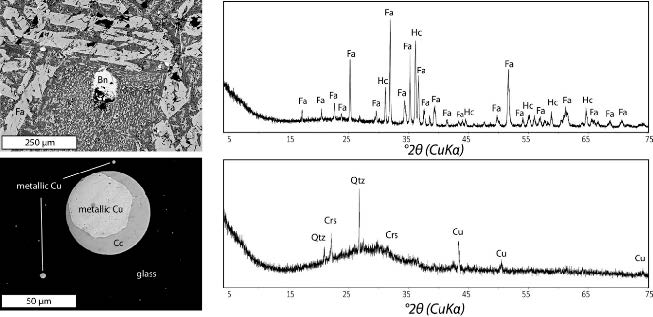
Shown in the figure above are scanning electron microscope images and XRD patterns of fresh samples of crystalline (upper pictures) and amorphous slag (bottom pictures). Abbreviations: Fa: fayalite, Hc: hercynite, Qtz: quartz, Crs: cristobalite, Cu: metallic copper, Bn: bornite, Cc: chalcocite.
Two types of slags (amorphous slag—AS, and crystalline slag—CS) were subjected to 24 to 48 h of leaching with:
i) Sulfuric acid at 0.1, 0.5, and 1 M concentrations at 1%, 5%, and 10% pulp densities (PDs); and
ii) normality equivalent (2 N) acids (sulfuric, hydrochloric, nitric, citric, and oxalic) at pulp densities ranging from 1% to 2%.
Bioleaching experiments were performed within 21 days with Acidithiobacillus thiooxidans accompanied by an abiotic control (sterile growth medium). The results demonstrated that the most efficient treatment for amorphous and crystalline slag was bioleaching at 1% PD over 21 days, which led to extraction
of Cu at rates of 98.7% and 52.1% for AS and CS, respectively. Among the chemical agents, hydrochloric acid was the most efficient and enabled 30.5% of Cu to be extracted from CS (1% PD, 48 h) and 98.8% of Cu to be extracted from AS (1% PD, 24 h).
Slag residues after leaching were characterized by strong alteration features demonstrated by the complete dissolution of fayalite in the case of CS and the transformation of AS to amorphous silica and secondary gypsum. Based on this study, the authors concluded that amorphous slag is a more suitable candidate for potential metal recovery because of its generally high susceptibility to leaching and due to the generation of residue significantly depleted in metals as the end product.
The inventory of economically relevant metals showed that 1 ton of historical copper slag contains metals valued at $47 and $135 for crystalline and amorphous slag, respectively, suggesting that secondary processing of such materials can potentially be both economically and environmentally viable.
Managed & Built by I2M Consulting, LLC | © 2010-
