

Kadziolka and4 co-authors reported in 2020 that temperature is a crucial factor influencing the effectiveness of metal smelting process. When studied in historical slags it provides information on the evolution of smelting technologies over time and how humankind approached metal recovery.
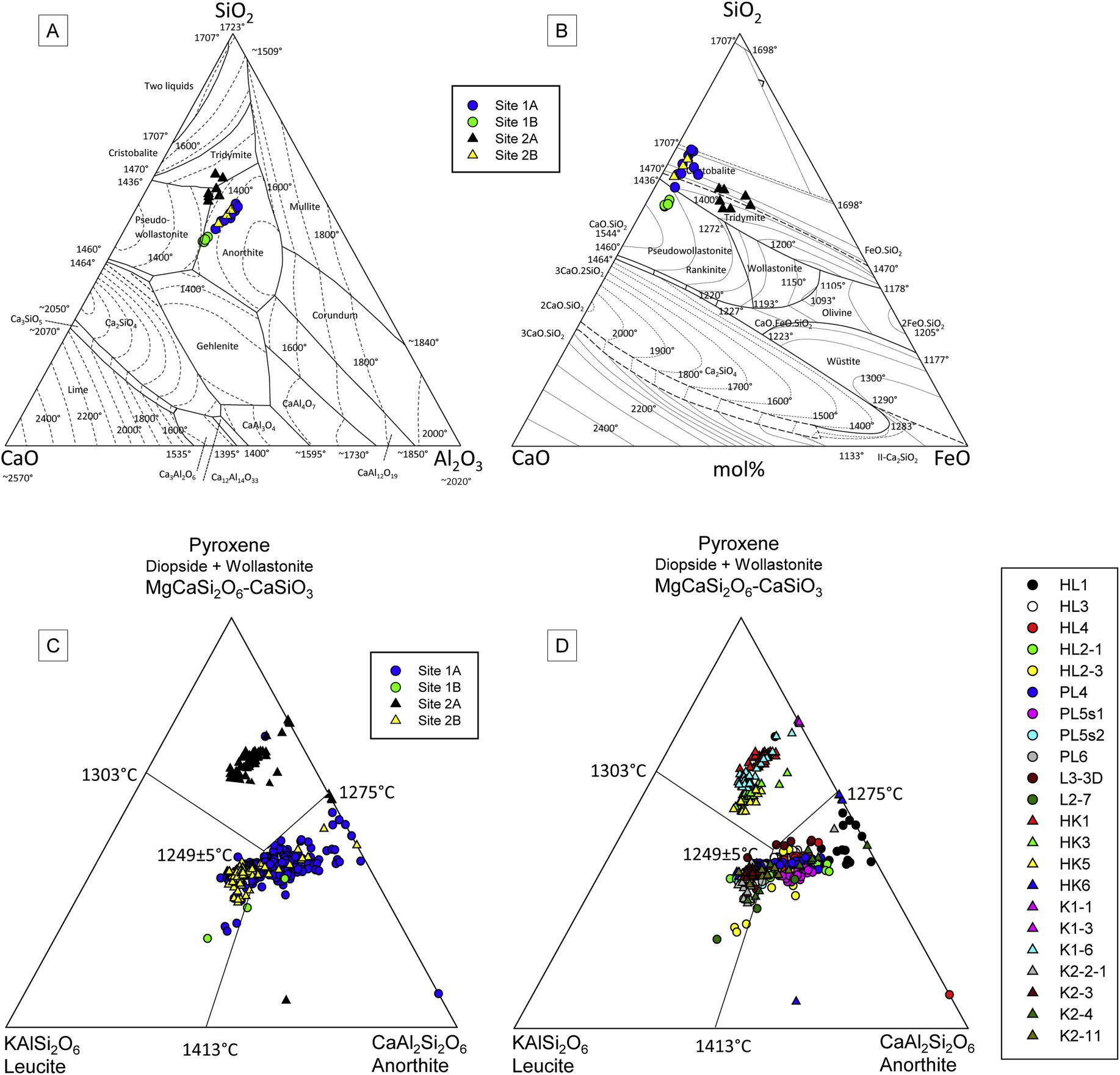
As shown in the above figure, the chemical composition of slags in the CaO–SiO2–Al2O3 and CaO–SiO2–FeO phase diagrams (A) and (B)(after Muan and Osborn, 1965; Piatak et al., 2015), Bottom: (C) and (D) shows the glass chemistry in a Leucite-Pyroxene-Plagioclase system based on CIPW calculations presented for sites and individual slag samples (after Gupta, 2015).
Samples from site 1B appear close to the eutectic line but only half of the samples (and a limited number of analyses among them) reached the required level of crystallizing at least 70% of diopside, plagioclase, leucite and wollastonite together. For this reason, most of the results do not appear on the diagram and temperatures estimated with this method are not certain for samples from this site.
Methodological approaches to temperature reconstruction using pyrometallurgical slags vary and this study serves as a critical review of the methods used so far with the complex historical smelting site used as an example of the application of the methods. The example includes silica-undersaturated, potassium-rich Cu slags from four sites in the Old Copper Basin (Stare Zagłębie Miedziowe), Poland, and is of particular interest because:
(a) K-rich slag compositions are not widely found and this provides additional challenge to temperature reconstruction approach and
(b) the site provides material of different ages (18th and 19th century) and, therefore, gives insight into potentially different pyrometallurgical processes.
Several methods are compared and include phase diagrams, geothermometry (Cpx-WR), thermodynamic modelling with MELTS software and temperature XRD analyses with the main implication that most of the methods have their merits, but modelling by MELTS software returns the most reliable estimates of liquidus temperature. In fact, MELTS is the only method that returns differences of 200°C in reconstructed temperatures between the studied sites, which signifies a change in smelting technique probably related to the change in input material.
More importantly, MELTS may also be used to estimate crystallization interval (temperature difference between solidus and liquidus) that together with liquidus temperature gives insight into metal extraction efficiency for a given site and provides information on society advancement in metallurgy. The software can also be used cost-effectively for a large number of samples and its combination with experimental approach (temperature XRD analyses)
provides the most promising tool to reconstruct differences in smelting technologies of ancient and historical metallurgical sites.
Managed & Built by I2M Consulting, LLC | © 2010-
