

Harshman and Adams reported in 1980 that the study of roll-type deposits during the past 20 years, since the first description of a deposit in the United States, has developed general concepts of ore formation, which are accepted widely and are compatible with available data.
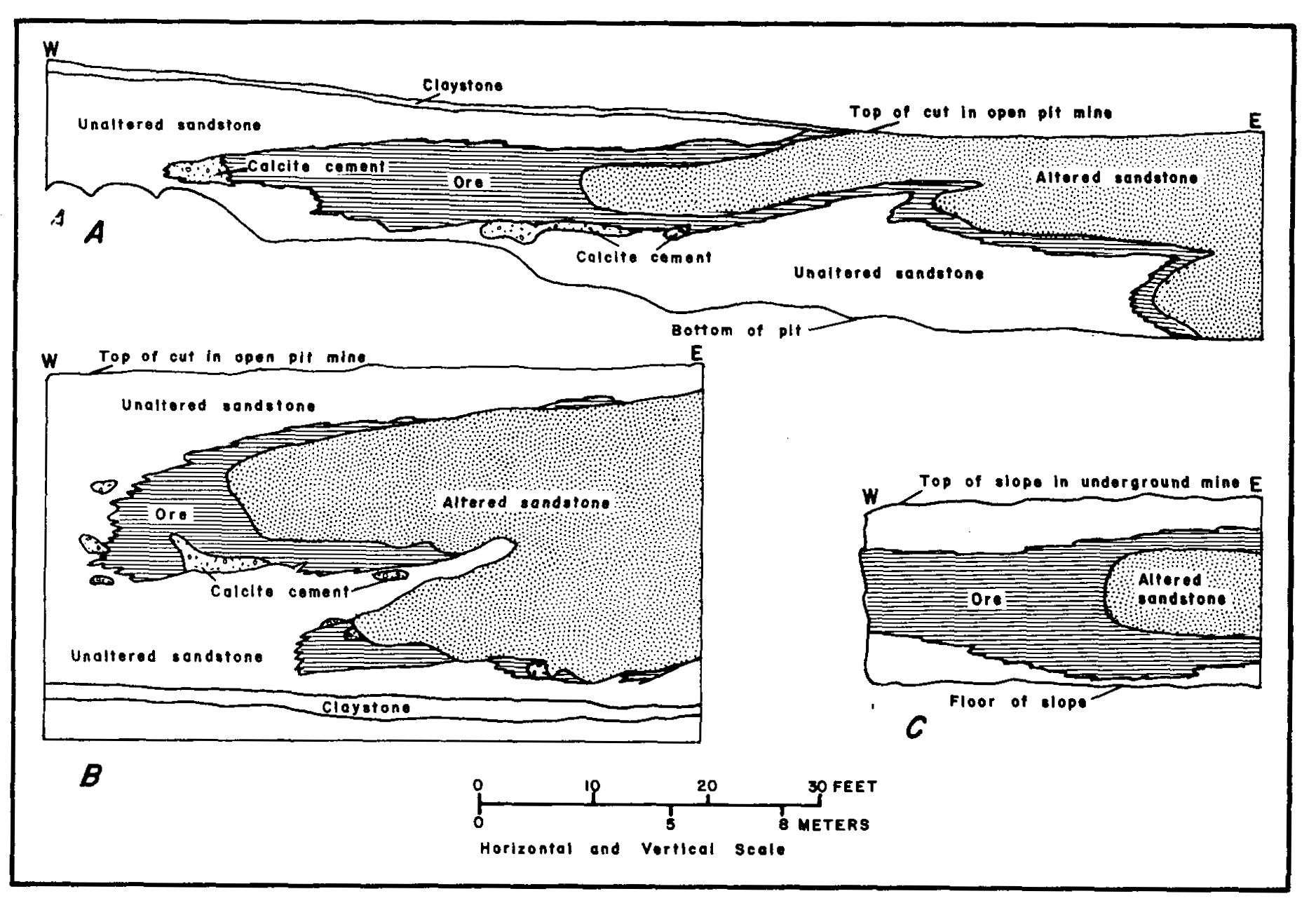 As shown in figure above are cross sections at west edge of upper altered-sandstone tongue, Shirley Basin, Wyoming (see Figure 7 in report). Sections A and B are in Petrotomics Co. Section 9 open pit mine. Section C is a simple "C" roll in the Utah International (now Pathfinder) underground mine (from Harshman, 1972).
If the above concepts were not appropriate and effective in locating ore, the concepts would not have endured and could not have been so successfully applied to exploration using the relations of "altered-unaltered sandstone." The comparative simplicity of the model, and the ease with which it has been applied to exploration have, oddly enough, probably inhibited detailed studies of ore districts that would have provided data now needed for refinement of ore controls for exploration and resource assessment programs.
The Shirley Basin data (Harshman, 1972) are drawn on heavily in this report. The most thorough study of a roll-type district was that of the general concept of roll-type formation provides a strong basis for the development of geological observations and guides, or recognition criteria, for resource studies and exploration. Indeed, industry has been developing and using them for 20 years.
As the objective of this study was to identify the most useful recognition criteria and develop a method for their systematic use in resource studies and exploration, the study is best summarized by reference to the important geological observations about roll-type deposits.
[Also see the current results of the search for uranium in the the I2M Web Portal (here).]
Managed & Built by I2M Consulting, LLC | © 2010-
