

Gaynor and two co-authors reported in late 2023 that reconstructing the tempo and emplacement mechanisms of large igneous provinces (LIPs) and establishing potential links to environmental change and biological crises requires detailed and targeted high-precision geochronology.
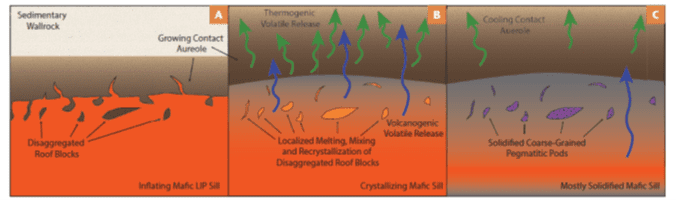
Shown in the figure above is a schematic model highlighting the process of LIP contamination at the emplacement level, from:
(A) initial LIP sill emplacement with diking and stopping of wall-rock blocks,
(B) wall-rock block melting during contact aureole development, and finally
(C) crystallization of the LIP sill with final thermogenic production with coeval crystallization of coarse grained enclaves.
The blue arrows indicate reactions associated with the release of volcanogenic gases, while the green arrows indicate the production and expulsion of thermogenic gases. No scale is implied. This model is based on work presented in Davies et al. (2021), Gaynor et al. (2022), and Deegan et al. (2022).
Contact metamorphism during LIP intrusive magmatism can release large volumes of thermogenic gas, so determining the timing of these events relative to global climate change is crucial. The most reliable age information comes from U-Pb geochronology; however, LIP mafic igneous rocks do not commonly crystallize U-bearing minerals, such as zircon or baddeleyite.
Recent work has shown that U-rich minerals can crystallize in fractionated melt pockets in intrusive components of LIPs after contamination of the melt by sedimentary rocks at emplacement level. Zircon and baddeleyite from these pockets make high-precision U-Pb geochronology of LIPs possible, but these unique mechanisms add other complexities.
The above is important because many of Earth’s Phanerozoic extinction events and major climate perturbations were coincident with the emplacement of large igneous provinces (LIPs), leading to the interpretation that continental flood basalt volcanism can trigger major anomalies in Earth’s climate (e.g., Courtillot and Renne 2003; Green et al. 2022). Early studies investigating mechanisms behind this correlation focused on the timing and rate of volcanic outpouring as a proxy for volcanic degassing and compared them to periods of global change (e.g., Courtillot and Renne 2003).
There was a paradigm shift beginning in the mid 2000s (e.g., Svensen et al. 2004), with researchers realizing the importance of the extensive subvolcanic (intrusive) record of LIPs on global climate. While both LIP eruptions and intrusions can rapidly emit massive volumes of volcanogenic gases (e.g., Capriolo et al. 2020), the emplacement of intrusions into sedimentary basins can also metamorphose organic-rich or evaporite-bearing sediments (e.g., Svensen et al. 2004; Heimdal et al. 2019). In these cases, contact aureoles around LIP intrusions can produce significant volumes of thermogenic gases from shales and evaporites (see Deegan et al. 2023 this issue; Svensen et al. 2023 this issue), substantially adding to the impact of these provinces.
Determining the age of these intrusions is required to link volatile outgassing to environmental and biotic impacts, the records of which are mostly from marine sedimentary successions. However, dating LIP intrusive events can be difficult, as mafic rocks preserved within a LIP’s plumbing system and intrusions do not typically crystallize minerals commonly used in high-precision U-Pb geochronology.
To assess the full impact of LIP events on the global climate, particularly the rate of change and durations of climate perturbations, it is crucial to develop complete chronological records of LIPs and connect them to the geological climate record.
Managed & Built by I2M Consulting, LLC | © 2010-
