

Dutkiewicz and 6 co-authors reported in early 2024 that the Sturtian “Snowball Earth” glaciation (ca. 717–661 Ma) is regarded as the most extreme interval of ice-house climate in Earth’s history. The exact trigger and sustention mechanisms for this long-lived global glaciation remain obscure. The most widely debated causes are silicate weathering of the ca. 718 Ma Franklin large igneous province (LIP) and changes in the length and degassing of continental arcs.
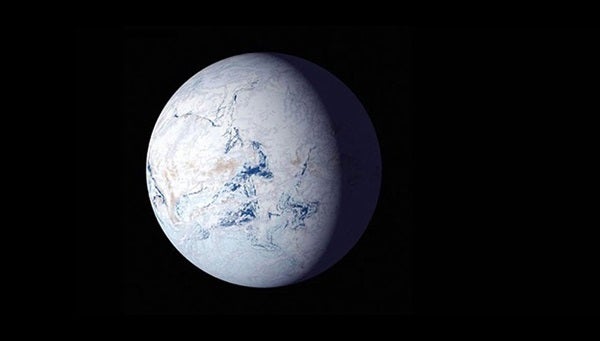 "Snowball Earth"
A new generation of two independent Neoproterozoic full-plate tectonic models now allowed the authors to quantify the role of tectonics in initiating and sustaining the Sturtian glaciation. They found that continental arc length remains relatively constant from 850 Ma until the end of the glaciation in both models and is unlikely to play a role. The two plate motion models diverge in their predictions of the timing and progression of Rodinia break-up, ocean basin age, ocean-basement depth, sea-level evolution, and mid-ocean ridge (MOR) carbon outflux. One model predicts MOR outflux and ocean basin volume–driven sea level lower than during the Late Cenozoic glaciation, while the other predicts outgassing and sea level exceeding those of the Late Cretaceous hothouse climate.
The second model would preclude a major glaciation, while the first model implies that the trigger for the Sturtian glaciation could have been a combination of an extremely low MOR outflux (∼9 Mt C/yr) and Franklin LIP weathering. Such minimal outflux could have maintained an icehouse state for 57 m.y. when silicate weathering was markedly reduced, with a gradual build-up of MOR CO2 in the atmosphere paired with terrestrial volcanism leading to its termination.
Managed & Built by I2M Consulting, LLC | © 2010-
