

Richard and 5 co-authors reported in 2013 that the Paleoproterozoic Athabasca Basin (Canada) hosts numerous world class unconformity-related uranium deposits. Many aspects of their genesis remain debated (as of 2013).
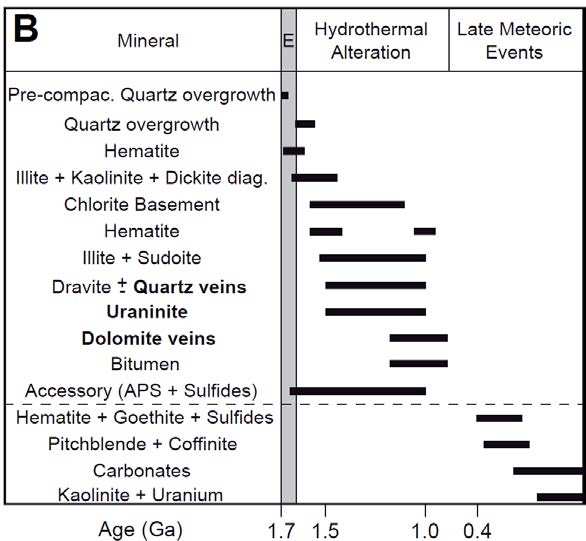
The figure above captures the simplified mineral successions (E: early diagenetic, hydrothermal and late meteoric) for unconformity-related U deposits in the Athabasca Basin (modified from Mercadier et al. (2012) and references therein). APS: aluminum phosphate-sulphate.
The authors reviewed recent fluid inclusion and stable isotope studies that have contributed to a better understanding of:
(1) the origin and P-T-X conditions of the mineralizing fluids;
(2) the conditions for transport of metals and in particular uranium;
(3) the relationships between fluid chemistry and alteration features (fluid-rock interaction) and
(4) some aspects of uranium deposition.
As a whole, the Athabasca system was dominated by basinal brines of evaporated-seawater origin. The brines have percolated through reactivated basement structures, leached metals in basement rocks, and caused intensive Mg-B alteration. Furthermore, the brines were anomalously acidic and
have transported the uranium at the highest concentration so far reported for crustal fluids. This feature alone could simply explain the spectacular
alteration and also the tremendous grades and tonnages of the Athabasca uranium deposits
Managed & Built by I2M Consulting, LLC | © 2010-
