

Deditius and two co-authors reported in 2007 that alteration of uraninite from a hydrothermal vein-type U-deposit in Marshall Pass, Colorado, has been examined by electron microprobe analysis in order to investigate the release and migration of trace elements W, As, Mo, Zr, Pb, Ba, Ce, Y, Ca, Ti, P, Th, Fe, Si, Al, during alteration, under both reducing and oxidizing conditions.
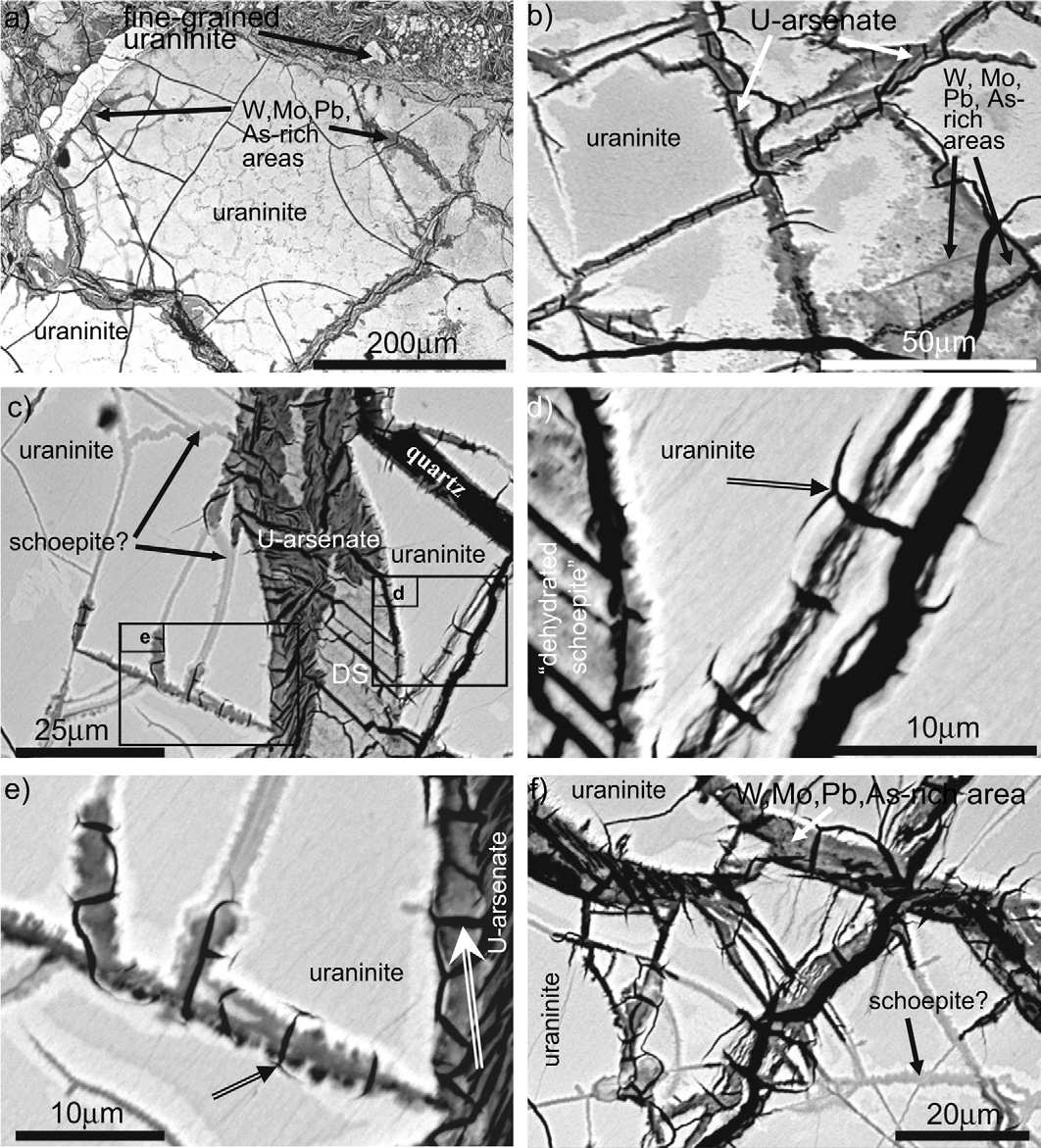
As shown in the above figure, BSE images of colloform uraninite from the Marshall Pass vein-type deposit consist of the following:
(a) Brecciated uraninite with alteration products concentrated along the grain boundaries (dark areas) and schoepite fills the fracture. The darkest areas are enriched in W, Mo, Pb, and As.
(b) Fragments of deformed uraninite with alteration along the fractures. Note the bright rim around the relatively unaltered cores.
(c to e) Uraninite grain altered along fractures and grain boundaries with alteration products and quartz. Note the microcracks caused by penetration of the cleavage planes of alteration phases (double white arrow) and their subsequent splitting along the boundary between gray and white areas (double black arrows). Separate fragments reveal extensively altered bright rim.
(f) Heavily deformed uraninite with fractures filled with quartz and a secondary uranyl phase enriched in W, Mo, Pb, and As.
The release of trace elements from uraninite is used to establish constraints on the release of fission product elements from the UO2 in spent nuclear fuels. Uraninite occurs with two different textures:
(1) colloform uraninite and
(2) fine-grained uraninite.
The colloform uraninite contains 1.04–1.75 wt% of WO3, 0.16–1.70 wt% of As2O3, 0.06–0.88 wt% of MoO3; whereas, the fine-grained uraninite retains 2.25–4.93 wt% of WO3, up to 5.76 wt% of MoO3, and 0.26–0.60 wt% of As2O3. The near constant concentration of incompatible W in the colloform uraninite suggests W-incorporation into the uraninite structure or homogeneous distribution of W-rich nano-domains. Incorporation of W and Mo into the uraninite and subsequent precipitation of uranyl phases bearing these elements are critically important to understanding the release and migration of Cs during the corrosion of spent nuclear fuel, as there is a strong affinity of Cs with W and Mo.
Zoning in the colloform texture is attributed to variation in the amount of impurities in uraninite. For unaltered zones, the calculated amount of oxygen ranges from 2.08 to 2.32 [apfu, (atom per formula unit)] and defines the stoichiometry as UO2+x and U4O9; whereas, for the altered zones of the colloform texture, the oxygen content is 2.37–2.48 [apfu], which is probably due to the inclusion of secondary uranyl phases, mainly schoepite.
The supergene alteration resulted in precipitation of secondary uranyl minerals at the expense of uraninite. Four stages of colloform uraninite alteration are proposed:
(i) formation of an oxidized layer at the rim,
(ii) corrosion of the oxidized layer,
(iii) precipitation of U6+-phases with well-defined cleavage, and
(iv) fracture of the uraninite surface along the cleavage planes of the U6+-phases.
Managed & Built by I2M Consulting, LLC | © 2010-
