

Nishant reported in 2016 on the uranium deposits of India. Jaduguda in Singhbhum Thrust Belt (in the state of Jharkhand, formerly part of Bihar) is the first uranium deposit to be discovered in the country in 1951.
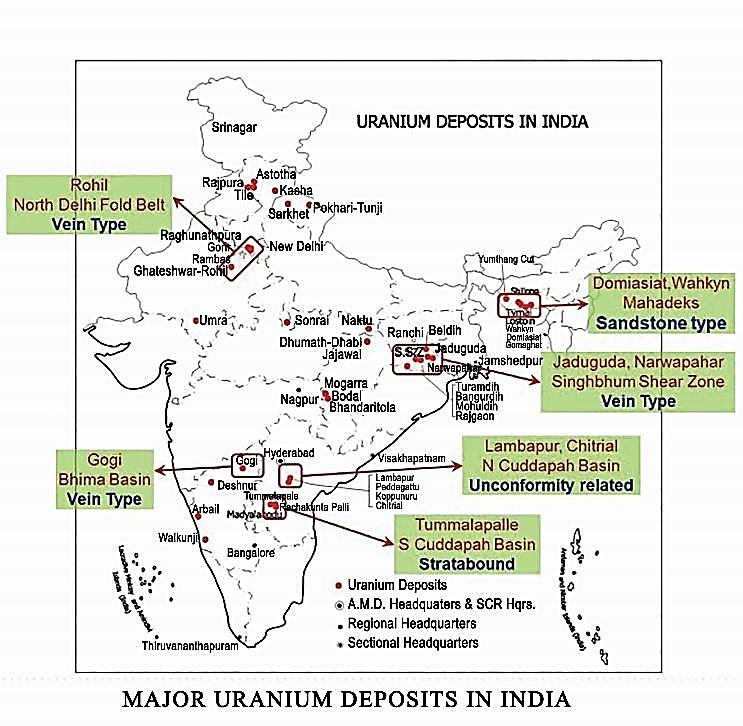 (Enlarged Map)
The Singhbhum Thrust Belt (also known as Singhbhum Copper belt or Singhbhum shear Zone) is a zone of intense shearing and deep tectonization with less than one km width and known for a number of copper deposits with associated nickel, molybdenum, bismuth, gold, silver etc. It extends in the shape of an arc for a length of about 160 km. The discovery of uranium at Jaduguda in this belt paved the way for intensive exploration work and soon a few more deposits were brought to light in this area.
Some of these deposits like Bhatin, Narwapahar and Turamdih are well known uranium mines of the country. Other deposits like Bagjata, Banduhurang and Mohuldih are being taken up for commercial mining operations. Some of the other areas like Garadih, Kanyaluka, Nimdih and Nandup in this belt are also known to contain limited reserves with poor grades. Apart from discoveries in the Singhbhum Thrust Belt, several uranium occurrences have also been found in Cuddapah basin of Andhra Pradesh. These include Lambapur-Peddagattu, Chitrial, Kuppunuru, Tumallapalle, Rachakuntapalle which have significantly contributed towards the uranium reserve base of India.
In the Mahadek basin of Meghalaya in North-Eastern part of the country, sandstone-type uranium deposits like Domiasiat, Wahkhyn, Mawsynram provide near-surface flat orebodies amenable to commercial operations. Other areas in Rajsthan, Karnataka and Chattishgarh hold promise for developing into some major deposits.
Uranium mining in India
The uranium mining in India made an exciting beginning with the formation of Uranium Corporation of India Ltd. in 1967 under the Department of Atomic Energy. Since then, the uranium industry of the country has recorded phenomenal growth in production and upgradation of technology. The corporation launched its operation with the commissioning of an underground mine and ore processing plant at Jaduguda (1968).
Subsequently, underground mines at Bhatin (1987), Narwapahar (1995) and Turamdih (2003) were commissioned. All these units are within 25 km from Jaduguda in the state of Jharkhand. The process plant at Jaduguda was progressively expanded embracing newer technologies to treat additional ore generated from the new mines.
Keeping in view the nation’s endeavor to expand nuclear energy infrastructure (20,000 MWe by 2020 AD from the present capacity of 2,770 MWe), new uranium mines are being opened by UCIL not only in the Singhbhum Thrust Belt of Jharkhand but also in other parts of the country.
Managed & Built by I2M Consulting, LLC | © 2010-
