

Bonnetti and 7 co-authors reported in 2016 that Carboniferous–Permian, Triassic and Jurassic igneous basement rocks around the Erlian Basin in northeast China have been investigated through detailed mineralogical, whole-rock geochemistry, geochronological data and Sm–Nd isotope studies.
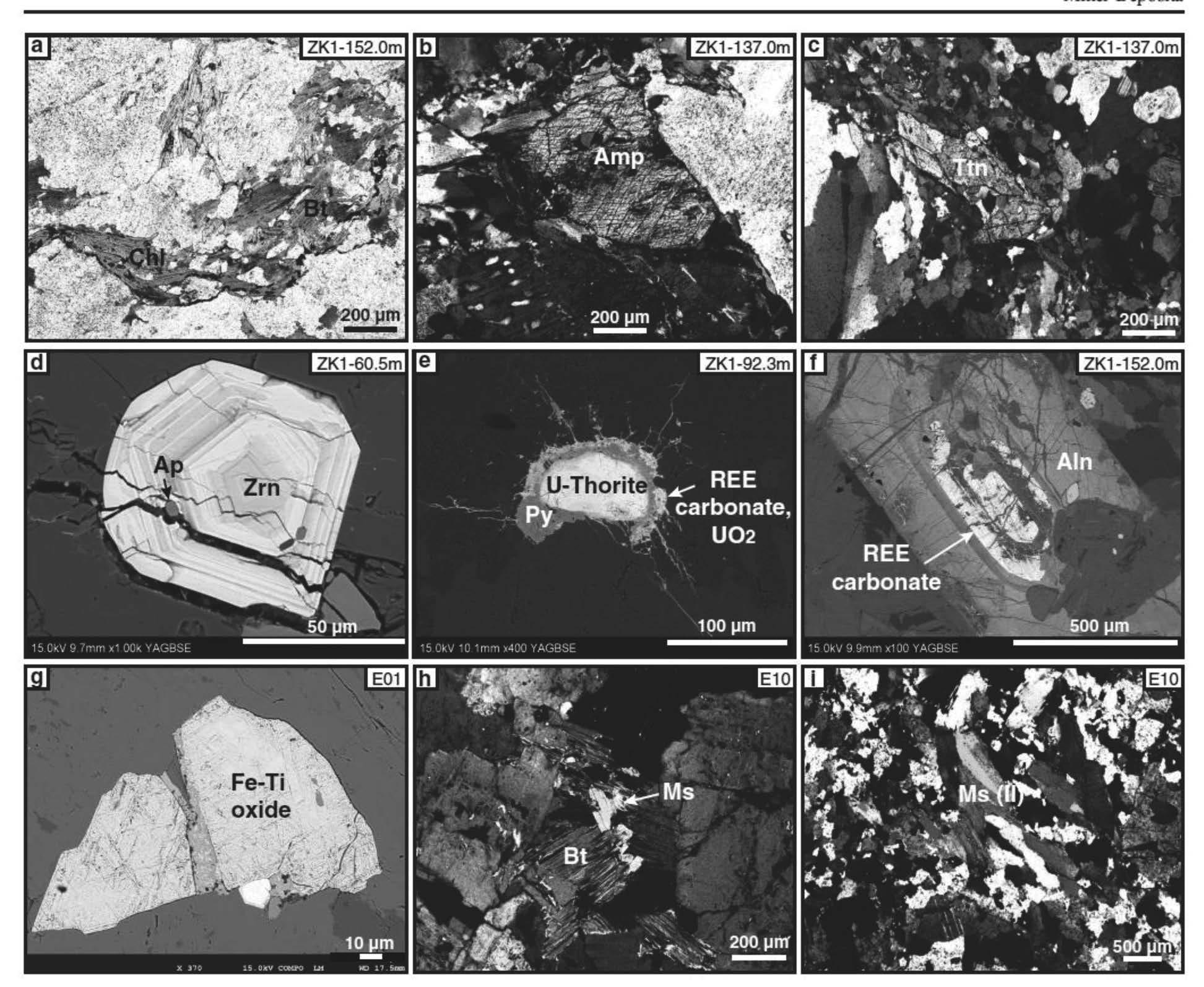
Shown in the above graphic are major and accessory minerals in biotite and two-mica granites of the basement surrounding the Wulanchabu and Manite sub-basins.
a) Biotite and chlorite (respectively Bt and Chl).
b) Amphibole (Amp).
c) Titanite (Ttn).
d) Zircon and apatite (respectively Zrn and Ap).
e) Metamict U-thorite showing a destruction rim associated with pyrite (Py), rare earth elements (REE) carbonate and uranium oxide.
f) Metamict allanite (Aln) associated with REE carbonate.
g) Fe–Ti oxide.
h) Biotite associated with muscovite (respectively Bt and Ms).
i) Secondary quartz and muscovite (MsII) in the greisenized part of the two-mica granite (next to the location of sample E10).
Carboniferous Permian biotite granites and volcanic rocks belong to a calc-alkaline association and were emplaced during the Late Carboniferous–Early Permian (313 ±1–286 ± 2 Ma). These rocks are characterized by positive εNd(t) (3.3–5.3) and fairly young TDM model ages (485–726 Ma), suggesting a dominant derivation from partial melting of earlier emplaced juvenile source rocks.
Triassic biotite granites belong to a high-K calc-alkaline association and were emplaced during the Middle Triassic (243 ± 3–233± 2 Ma). Their negative εNd(t) (−2 to −0.1) and higher TDM model ages (703–893 Ma) suggest a contribution from Precambrian crust during the magma generation processes, leading to a strong enrichment in K and incompatible elements such as Th and U.
Highly fractionated magmas crystallized in U-rich biotite (up to 21 ppm U) and two-mica granites. In biotite granite, the major U-bearing minerals are uranothorite and allanite. They are strongly metamict and the major part of their uranium (90 %) has been released from the mineral structure and was
available for leaching. Mass balance calculations show that the Triassic biotite granites may have, at least, liberated ~14,000 t U/km3 and thus correspond to a major primary uranium source for the U deposits hosted in the Erlian Basin.
Managed & Built by I2M Consulting, LLC | © 2010-
