

Alexandre and Kyser reported in 2006 that the sediment-hosted unconformity-type Southwest Athabasca uranium mineralization in northern Saskatchewan, Canada, contains uraniferous bitumen, as observed elsewhere in the Athabasca basin.
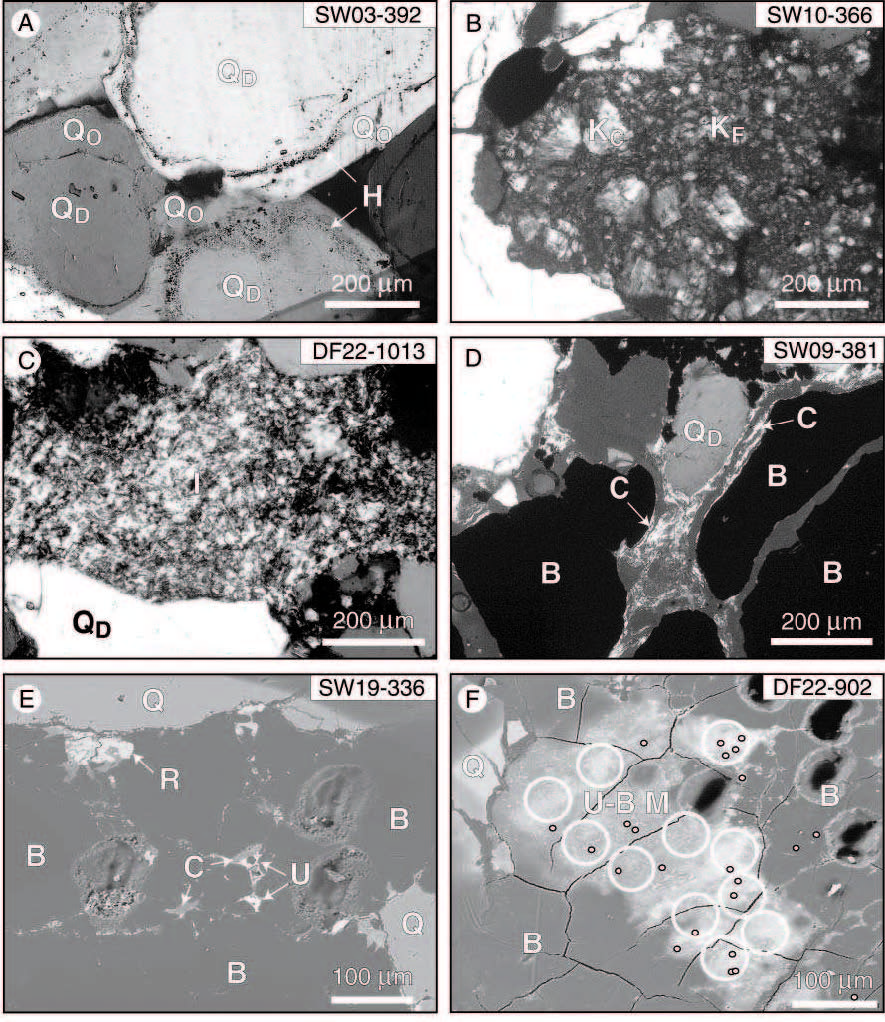 Shown in the above graphic is the transmitted light microscopy (A-D) and backscattered electron microscope (BSEM) (E, F) images of alteration assemblage and of uraniferous bitumen from the Southwest Athabasca.
A. Quartz overgrowth (QO) separated from detrital quartz (QD) by a hematite rim (H).
B. Fine- and coarse-grained kaolinite (KC and KF).
C. Illite alteration of kaolinite (I).
D. Uraniferous bitumen globules (B) rimmed by chlorite (C).
E. Typically globular bitumen (B) surrounded by quartz (Q), with uraninite (U), coffinite (C), and rutile (R) situated in the pore spaces left between the bitumen globules.
F. Mixture of less than micrometer-sized uraninite grains and bitumen (uraninite-bitumen mixture, or U-B M), surrounded by barren bitumen (B); the areas analyzed by LA-ICP-MS (large white-rimmed circles) and by electron microprobe (small black-rimmed circles) are indicated.
Uraninite is present either as micron-sized grains dispersed in bitumen (uraniferous bitumen) or as larger grains situated in the pore space between bitumen globules. The spatial and textural relationships between uraninite and bitumen suggest that they were co-precipitated. LA-ICP-MS U/Pb dating of uraniferous bitumen yielded an age of 1,575 ± 53 Ma, similar to that of other unconformity-type uranium mineralization in the Athabasca basin, indicating that the bitumen was formed early in the history of the basin. Nitrogen, carbon, and sulfur isotope analyses of uraniferous bitumen indicate that its source material was probably kerogen produced by cyanobacteria in a clastic environment.
The authors concluded that the Southwest Athabasca uranium mineralization is distinct from most other deposits in the Athabasca basin. Although bitumen has been reported elsewhere in deposits of the Athabasca basin, in the Southwest Athabasca project it appears to be much older. The authors also concluded that, at least in this case, bitumen precipitated before or contemporaneously with uraninite and served as a reductant for uranium precipitation. As a result, uraninite is present either as micro-sized grains disseminated in the mass of the bitumen, or as larger grains situated in the pore space between bitumen globules.
The Southwest Athabasca mineralization was formed during the same major uraninite precipitation event at ~1590 Ma, observed throughout the Athabasca basin (see Alexandre and Kyser, 2003), and has other characteristics in common with all deposits in this basin, such as the origins of uranium and of the alteration and precipitation fluids (see Alexandre et al., 2005).
The main difference is that the reductant for uraninite precipitation is bitumen, which could potentially result in deposits forming far above the unconformity where most other deposits are located. However, the distribution of the bitumen could also result in numerous small occurrences of uranium mineralization that are unfavorable for exploration.
Managed & Built by I2M Consulting, LLC | © 2010-
