


Mercadier and 7 co-authors reported in 2011 that uranium deposits form in a wide range of geological settings, including deep magmatic to surficial conditions, and range in age from Archaean to recent (oceans). These temporal and spatial variations have given rise to an extreme diversity of ore deposits. However, understanding their conditions of formation has remained challenging.
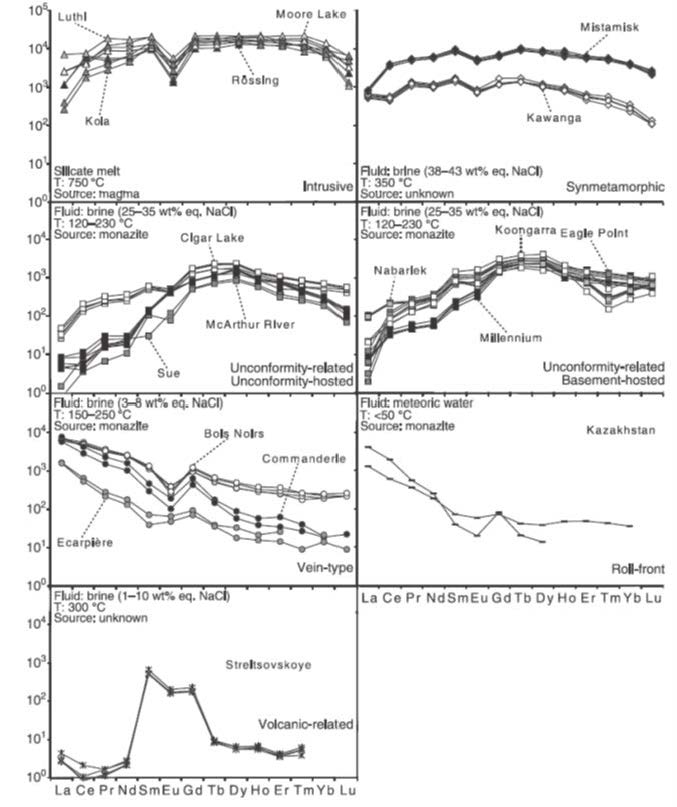
For example, as shown in the above figure, chondrite-normalized rare-earth element patterns for uranium oxides from six different types of uranium occurrences. For each type, three key genetic parameters are highlighted:
- nature of the mineralising fluid (Fluid),
- temperature of ore formation (T), and
- source of the REE (Source).
The given REE source is the proposed-to-be dominant source. The genetic parameters are from references summarised in Table 1 (Electronic Supplementary Material). See Table 2 (Electronic Supplementary Material) for analytical data. For SIMS analysis, Gd and Yb values are calculated from: Gd*=1⁄3*Sm + 2⁄3*Tb, Yb* = 0.5*Tm + 0.5*Lu (see Fig. 1 in Electronic Supplementary Material for explanation). Chondrite values are from Anders and Grevesse (1989).
The authors reported on rare earth element (REE) abundances, measured by microbeam methods in uranium oxides, for a series of worldwide uranium occurrences. The REE patterns are very specific to each deposit type and directly reflect the conditions of their genesis.
The authors proposed an evaluation of the first-order parameters controlling the REE behaviour in each mineralized system. This study demonstrates that the REE pattern is the most efficient tool for constraining the geological models of uranium deposits and for genetically discriminating new uranium discoveries. This approach may form the starting point for a new procedure in the fight against nuclear ore trafficking.
This study clearly demonstrates that the uranium oxides have REE abundances directly dependent of the geological conditions linked to uranium oxide formation. The uranium oxide REE patterns are a key for a definition of meaningful genetic models. The application of this method to all known uranium deposit types, coupled with conventional isotopic techniques, will therefore greatly improve the understanding of the geology of this complex metal and will help in the discovery of new uranium deposits.
Additional discussions are provided (here).
Managed & Built by I2M Consulting, LLC | © 2010-
