

Amer and three co-authors reported in mid-2021 that the A-type younger granite pluton and associated fluorite of Gabal El-Erediya, Eastern Desert, Egypt, have been investigated geologically and geochemically.
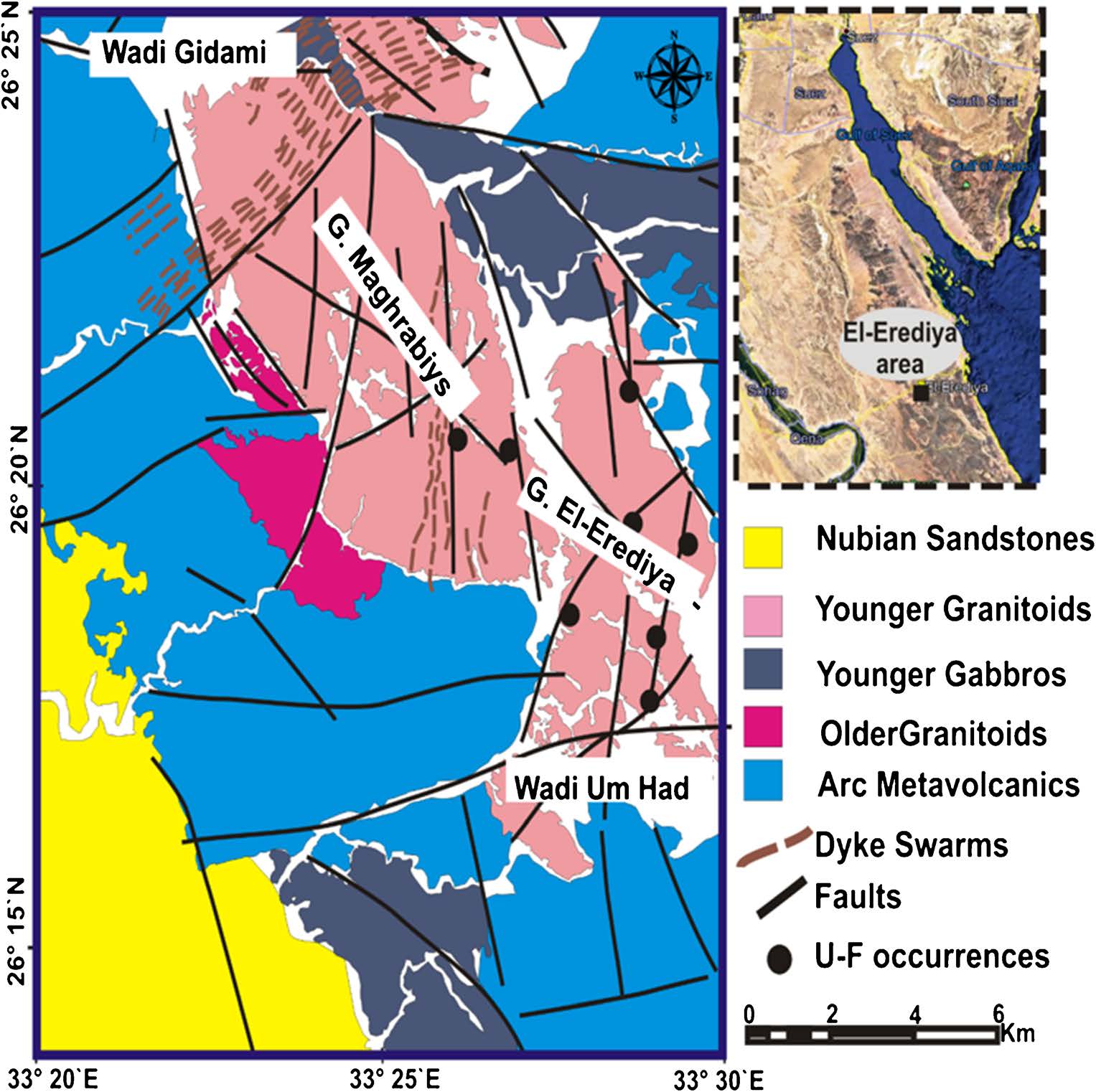
Granites are genetically high-K-calc-alkaline syenogranites that show a high LREE/HREE ratio with noticeable negative Eu anomaly. Additionally, the visible tetrad pattern and negative Eu anomaly of the investigated granites point to fractional crystallization and fluid-melt interactions during the last stage of magmatic differentiation. They were probably generated within an extensional environment and were crystallized at temperature ~ 740°C and pressure ~ 1.9 kbars.
Two types of U-rich fluorite mineralizations were recorded including colorless and violet types. The hydrothermal fluids forming fluorites were related to late-stage differentiation of the felsic magma with a crystallization temperature ranging from 118 to 336°C.
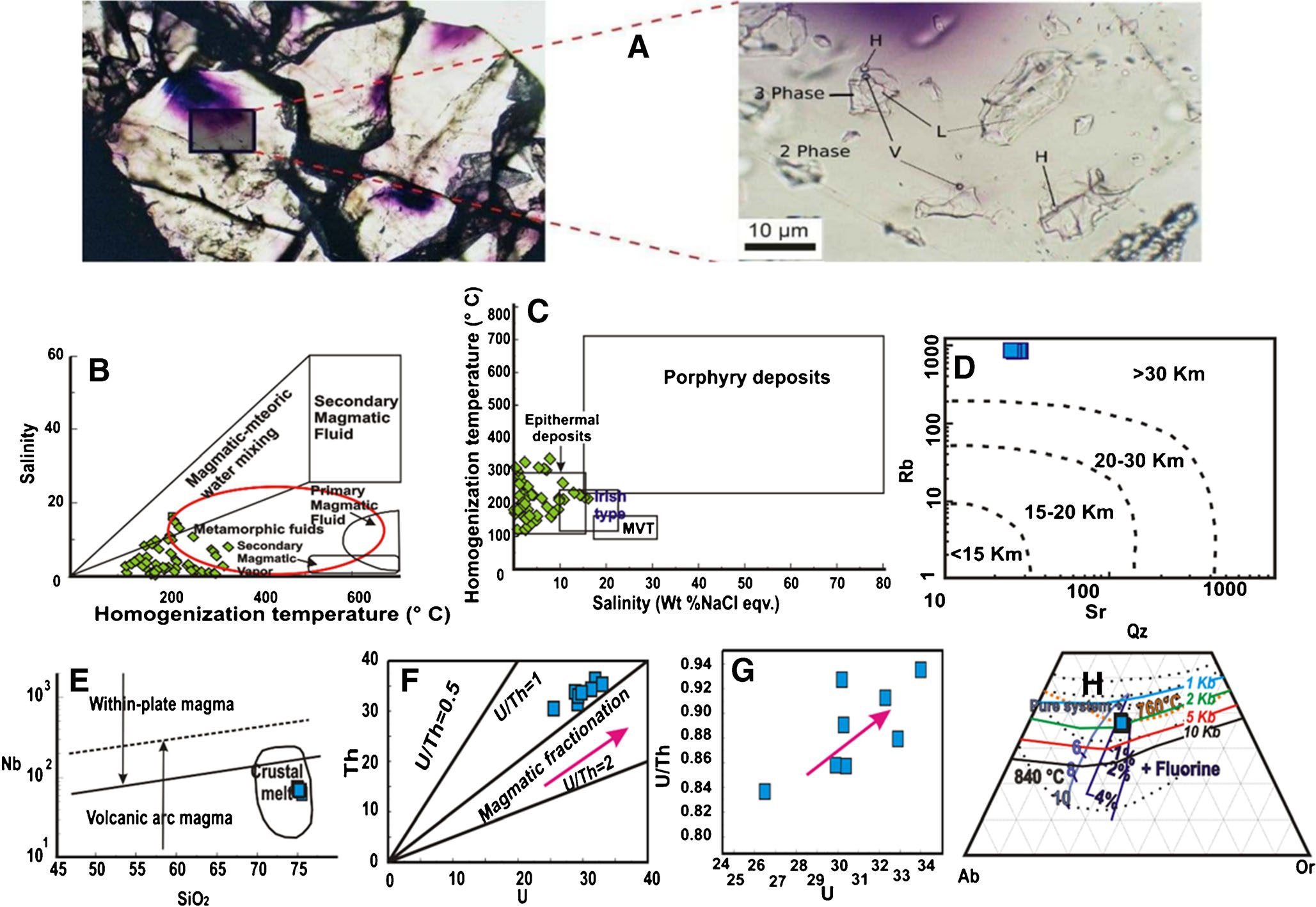
In the figure above, photomicrographs of fluid inclusions in fluorite show three phases H+V+L, and two phases:
(A) homogenization temperature versus salinity diagram for fluid inclusions (after Beane (1983));
(B) homogenization temperature-salinity diagram (after Wilkinson (2001));
(C) Rb-Sr variation diagram (Condie 1973);
(D) SiO2-Nb variation diagram proposed by Pearce and Gale (1977);
(E) U-Th (F) and U-U/Th;
(G) diagrams (the trend after Cuney (2009)); normative An-Ab-Or ternary graph; and
(H) temperature dotted lines (Barker 1979), the pressure solid lines (Johannes and Holtz 2012), and fluorine content (Manning 1981).
Managed & Built by I2M Consulting, LLC | © 2010-
