

Favera and Chaves haves reported in 1998 that In the Brazilian territory. the gondwanic coal ( Kungurian. Early Pem1ian) of the Parana Basin, extends in a discontinuous belt parallel to the eastern margin of the basin. from the Rio Grande do Sul to the Sao Paulo state.
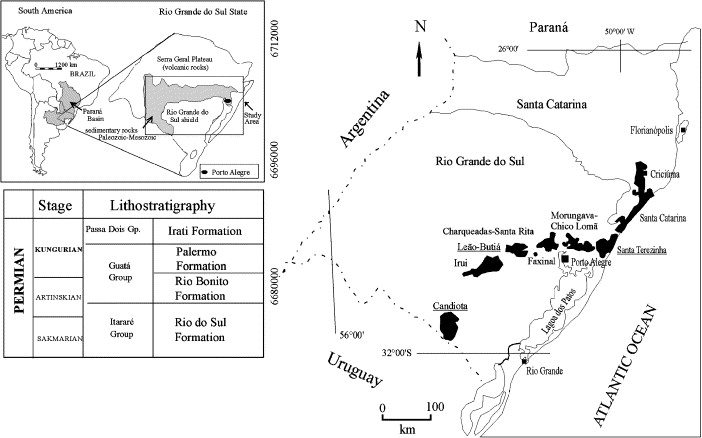
Most of the coal beds are in the Sideropolis Member of the Rio Bonito Formation in a barrier-bar lagoon setting, as seen in the Criciuma area, Santa Catarina state; others are in the deltaic section of the Triunfo Member. at the base of the same formation.
In the Criciuma area, detailed stratigraphic sections were prepared, with the datum chosen in a stratigraphic marker bed above the last coal bed, near the transition Rio Bonito-Palermo formations. These sections show undulating geometries affecting the coal beds. These beds are supposed to be continuous as a result of deposition in a single lagoon where favorable conditions for coal development were attained. At the same time. sand bodies, assumed to be the depositional barrier-bar counterparts of the lagoon, changing their thickness across the belt. The only plausible explanation for this configuration is the presence of growth faults acting during deposition, as shown in modern examples of Niger delta, which presents barrier bar-lagoon settings.
The same is reported in the Figueira area, Parana state, where the coal beds are situated in the basal member of the Rio Bonito0 Formation. In this area, coal is associated with deltaic sediments and growth faults, with the characteristic low-angles planes, are seen everywhere along an open-pit mine.
Growth-faults are diastrophic in nature. being mostly due to the sand overload by fluvial-dominated delta deposition or by sandstone lobes exhibiting hummocky cross stratification in barrier bars formed by storm-related processes after marine transgressions in storm-wave-dominated deltas.
Managed & Built by I2M Consulting, LLC | © 2010-
