

Richard and 5 co-authors reported in 2015 that spectacular alteration of monazite by diagenetic/hydrothermal brines has been well documented in some Proterozoic sedimentary basins in close relationship with high-grade uranium (U) deposits.
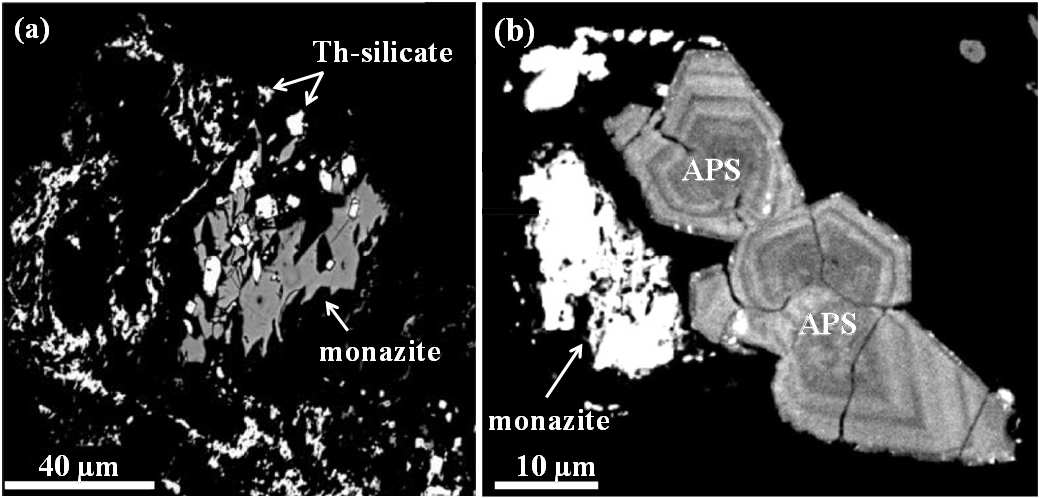 Examples of intensive alteration of monazite by diagenetic/hydrothermal
brines from the basement of the Proterozoic Athabasca Basin (Canada):
a) Back-scattered electron image of a monazite grain (grey), which
is nearly completely altered to Th-silicate (white) (modified).
b) Back-scattered electron image of a relict monazite (white) associated
with aluminum phosphate-sulfate mineral (APS) (grey) (modified).
Hence, monazite has been proposed as a viable source for some U deposits. However, monazite alteration remains enigmatic with regard to its high stability in relatively low temperature hydrothermal conditions. The authors reported that batch experiments in which 10 mg of natural monazite grains were reacted with 15 mL of Na-Ca-Cl (6 molal Cl) solutions as well as in pure water at 150°C and saturated vapor pressure (Psat) for one and six months. The influence of pH (pH = 1, 3, 7) and relative molar proportions of Na and Ca (Na/(Na + Ca) = 0, 0.5, 1) were all tested.
Discrete alteration features (etch pits and roughened surfaces) appear in a minority of the one month experiments and are more developed in the six months experiments, especially at pH = 1 and 3. Although spectacular alteration of monazite, as seen around U deposits, it could not be reproduced by the authors for this study. They showed that monazite is unstable in the presence of fluids analogous to acidic deep basinal brines, [deep groundwater with very high salt?].
Managed & Built by I2M Consulting, LLC | © 2010-
