

Wang reported in mid-January 2024 that there haven't been full-scale nuclear thermal rocket engines built and tested on the ground since the 1960s. The US had the NERVA project. The attraction is that the ISP would be up to triple the ISP of chemical rockets.
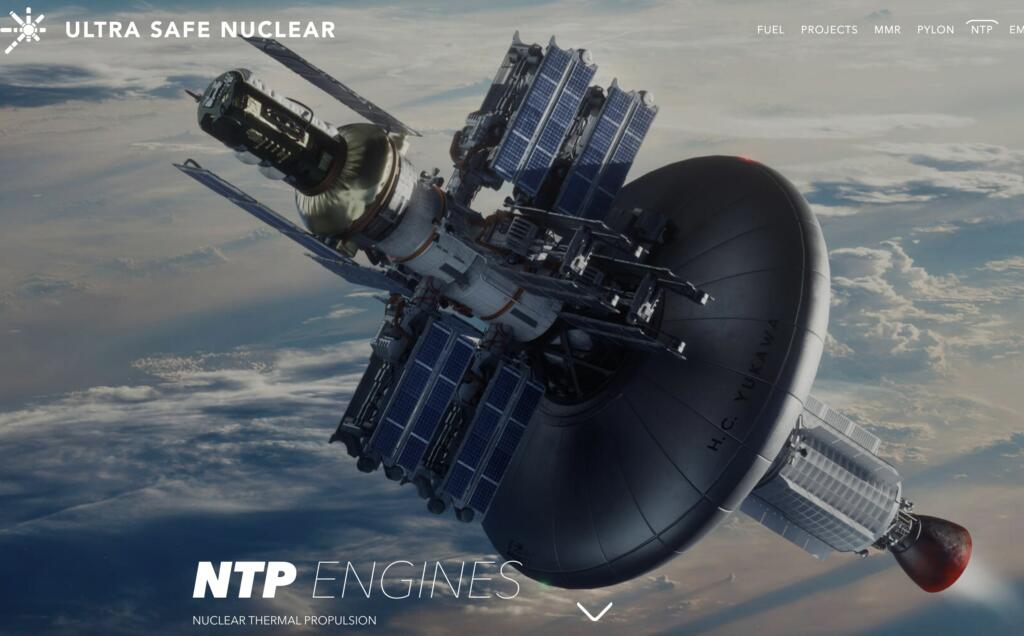
Specific Impulse, or ISP, is a measure of a rocket engine's efficiency. It is calculated relative to the Earth's gravitational field, where ISP = ve/go, with go= 9.8 m/s2 and the escape velocity of the propellant, ve, in m/s. Chemical rockets have ve< 4.4x10³ m/s and ISP<450 seconds.  Nuclear thermal propulsion (NTP) systems work by heating up a gas, usually hydrogen or ammonia, with a nuclear fission reactor and expanding that gas through a nozzle to produce efficient thrust. All of the radiation is contained under normal operation. NASA and the US government is again funding nuclear thermal rockets. There have been off and on nuclear thermal rockets program since the 1960s.
In 2022, DARPA announced its goal of conducting an in-space flight demonstration of nuclear thermal propulsion in 2026. In January 2023, NASA and DARPA announced a partnership to test a nuclear thermal rocket (NTR) engine in space as part of the Demonstration Rocket for Agile Cislunar Operations (DRACO) program. The goal of the DRACO project is to demonstrate revolutionary propulsion technology. This will be a smaller rocket that will only work in space. It will not take off from the ground.
ISP, as indicated above, is a measure of fuel efficiency. Higher ISP is good because if two rockets have the same amount of fuel, then they could have thrust for longer with more fuel efficiency. This would in general mean more speed and faster travel times. However, if the rockets are not equal in fuel then a lower fuel efficiency rocket can get to the same or higher speed.
If SpaceX has fully reusable Starships, then they could bring up loads of methane fuel and keep it in fuel depots. They could refuel rockets. They can launch a Mars rocket with multiple tanker rockets. The tanker rockets would act as another stage. The tanks would also need to fly at the same speed. They could all use up 80% of their fuel. Four tankers could then refuel the main rocket. It could be fully refueled for a final burst of speed or to decelerate from double the normal speed.
Ten or twenty launches and refuelings could be very expensive. However, if the rockets are fully reusable then it is only the incremental cost of fuel. This could be as little as $200,000 to $2 million.
Managed & Built by I2M Consulting, LLC | © 2010-
