

Rao reported in mid-January 2024 that water might've existed in the building blocks (aka asteroids and/or comets) coming to of our world.
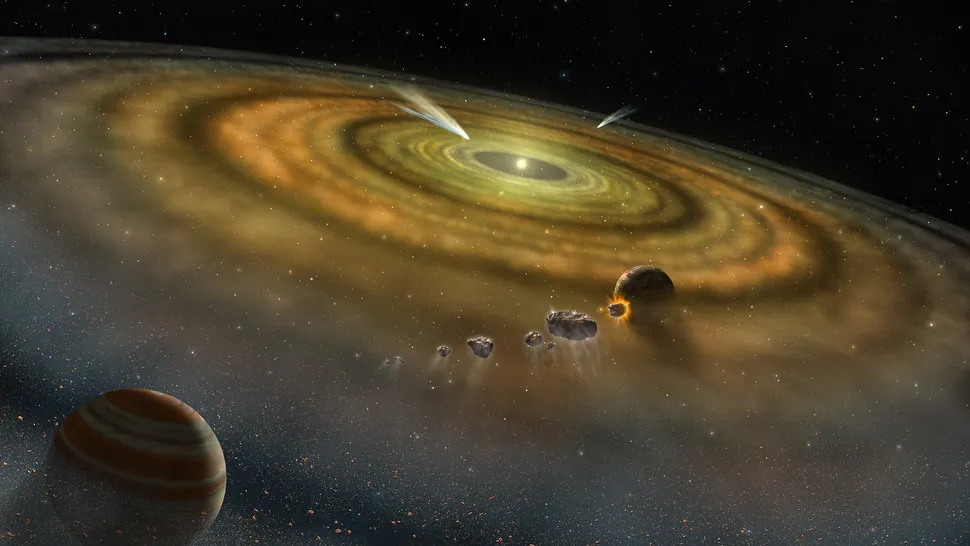 Depiction of planets forming from a disk of material surrounding a star.
(Image credit: NASA)
Earth and the rest of our solar system's inner, rocky planets are the products of a myriad of tiny planetesimals — glorified pebbles of primordial cosmic dust — assembling themselves together more than 4 billion years ago. Now, a new analysis suggests that those planetesimals already contained water.
Researchers tested samples from meteorites that they say are just as ancient as those planetesimals. In doing so, they found the fingerprints of chemical reactions known to occur in the presence of water.
There is no water to be found in these samples today, but scientists can still trace water that they once held. Over time, if water is in the presence of other elements, the water molecules' oxygen atoms will separate and join up with those very elements. Water and iron, for instance, will beget iron oxide. That's the substance that colors Mars’ surface rust-red. However, even that iron oxide is now long gone in the meteorites — but when it faded, it would have taken a little bit of the meteorites' iron content away with it. So, scientists can test for ancient water by measuring a meteorite's iron level in comparison to the space rock's other elements.
Researchers expected to find about as much iron as nickel and cobalt. But instead, they found quite a lot of missing iron in comparison — implying the presence of oxygen and, by extension, water. In short, they concluded that the primordial material that formed the inner solar system likely included water.
"The difference between what we measured in the inner solar system meteorites and what we expected implies an oxygen activity about 10,000 times higher," said Paul Asimow, a geologist and geochemist at the California Institute of Technology, in a statement.
If water's hydrogen and oxygen were present in these primordial planetary building blocks, then it is a good sign that other elements — carbon and nitrogen, critical to creating life — may have been there at the start, too.
The researchers' work is outlined in a paper published in the journal Nature Astronomy on Jan. 9.
Related Articles:
:
— Meteorites and volcanoes may have helped jump-start life on Earth (here);
— Scientists may have uncovered the oldest evidence of a meteoroid hitting Earth ever (here);
— Where did Earth get its water? It was sucked up from space, new theory says (here);
— How giant impacts shaped the formation of the solar system's planets (here).
— Early Meteorites Might Have Brought Enough Water to Mars to Create a Global Ocean - 2022 (here);
— Formation of the Moon Brought Water to Earth - New Research Shows How Earth Became a Habitable Planet (here);
— Space Dust Delivered Water to Vesta, Could it Have Done the Same for Earth? - 2020 (here); and
— Rare Meteorite that Fell to Earth Reveals Where Earth’s Water Came From? - 2022 (here).
Managed & Built by I2M Consulting, LLC | © 2010-
