

Shin and Jun-Cho reported in 2011 that today, the global competition to secure energy resources is an important factor in national development and survival, requiring active and strategic measures and investments at the government-wide level.
In particular, nuclear power accounts for approximately 40% of total domestic electricity production in Korea as of 2011, and the proportion of nuclear power is expected to continue to increase in the future, reaching approximately 50% by 2022, making securing uranium raw materials a very important national issue. am. Until the mid-1990s, in order to secure uranium resources, geological and geochemical surveys, aerial and radioactivity surveys, detailed mineral deposit surveys, and drilling surveys were conducted in the Okcheon Formation Group in Korea.
Recently, research has been conducted on promising domestic uranium mineralization zones, but as the uranium ore has been reconfirmed to be of low grade with only an average of 0.04% U3O8, development has not yet been carried out and the country is entirely dependent on imports of uranium. For several years now, foreign companies have been interested in and are pursuing uranium exploration and development in promising mineralization zones in Korea.
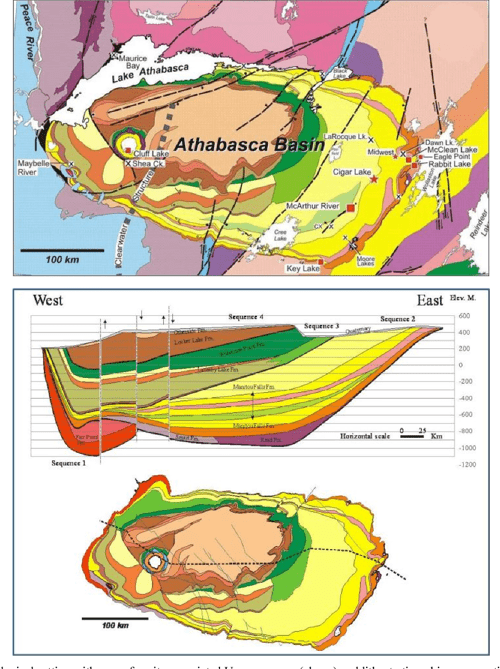
There are 14 types of uranium deposits known (OECD/ NEA & IAEA, 2008), and the deposit types currently mainly produced include unconformity-related type, brecciated complex type, and sandstone type. In particular, active exploration and development of mismatch-related uranium deposits has been actively carried out in Canada recently, and related domestic companies have also formed consortiums since the late 2000s, and as of 2011, Saskatchewan, Canada. ) is actively participating in the exploration and development of unconformity-related uranium deposits developing in the Athabasca Basin, located in the northwestern part of the state.
The uranium deposits in this region are of high quality, represent the world's largest reserves, and form the center of Canadian uranium production. The most representative deposits include the Cigar Lake deposit, where 875 kt ore has an average grade of 15%, and McArthur River's 1,017 kt ore has an average grade of 22.28%. The grade of all 30 or so uranium deposits developed to date in the Athabasca Basin, including these two deposits, is lower grade at 1.97%, but this is significantly higher grade than other uranium deposits in Canada and Australia (Table 1).
See reference (in English) for numerous publication on the Athabasca Basin uranium.
Managed & Built by I2M Consulting, LLC | © 2010-
