
Uranium Potential in Utah - 2005
Uranium (Nuclear Minerals) / Exploration, Mining, Marketing, & Acquisitions
Date posted: 01/19/24
Gloyn and Krahulec reported in 2005 that Utah has been a moderate uranium producer, accounting for a total of about 130 million pounds of U3O8. The vast majority of its production has come from small, low- to moderate-grade sandstone-hosted uranium deposits of the Colorado Plateau, typically worked by underground methods.
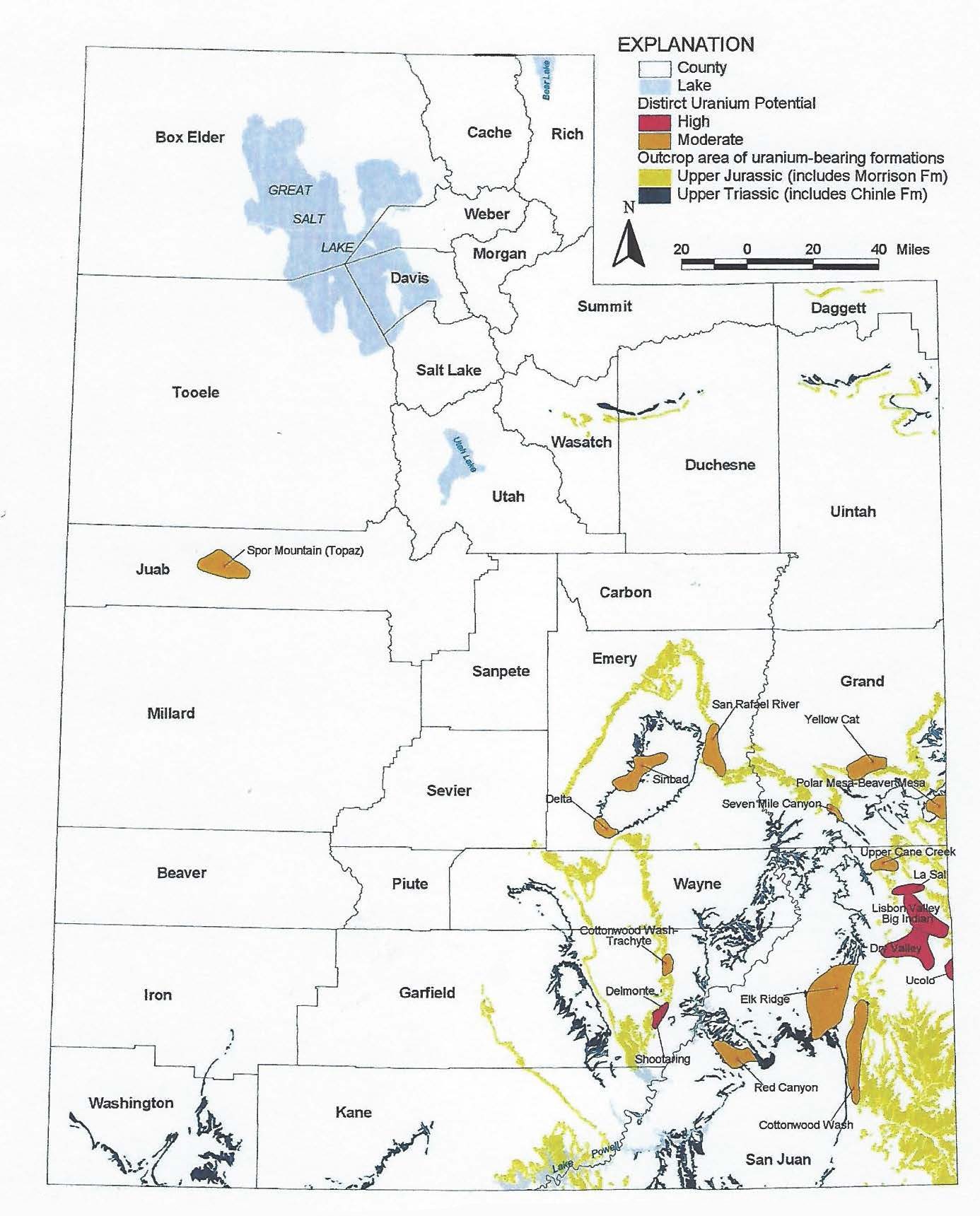
Mining districts with the best uranium potential (as defined by R.W. Gloyn
in 2004). The generalized outcrop patterns of the major uranium host strata
are shown for reference (Hintze and others, 2000).
Four of the five areas listed as having high potential lie in the Paradox Basin of San Juan County: Lisbon Valley, La Sal, Dry Valley, and Ucolo.The Lisbon Valley - Big Indian mining district is Utah's only large uranium producer (53,636,121 pounds of U3O8). The other high potential district is Shootaring-Del Monte district in the southern Henry Mountains of Garfield County. Utah's largest known remaining uranium resource, although moderate-grade (0.22% U3O8), is the Bullfrog-Tony M. deposits (23,822,000 pounds of U3O8) in the Shootaring-Del Monte district, near the Shootaring Canyon mill.
Due to its existing infrastructure and defined resource, this deposit has the best opportunity to become a producer during the current upswing in the uranium market (i.e. 2005), but with the higher uranium prices (2024) comes increased mining activity, especially in Utah (here).]
An additional dozen uranium mining districts are judged to have moderate potential. No sandstone-hosted deposits are currently (2005) being mined by underground methods in the U.S. U.S. primary uranium production comes dominantly from in-situ leaching (ISL) deposits. Utah may have some potential for ISL from the Tertiary sediments in the Spor Mountain district and the little reported uranium-copper occurrences of the Uinta Basin.
Utah has also produced minor amounts of by-product uranium and there may be some potential for additional production from the beryllium and phosphate
producers in the state and possibly Bingham Canyon. Bingham Canyon recovered uranium temporarily from dump-leach water when the price was high in the 1980s. Similarly, Brush Wellman has recovered uranium, which is generally considered a contaminant along with fluorine and yttrium, from their Spor Mountain beryllium operations.
Updated in 2008 (here).
Utah Geological Survey updates (2023).
Managed & Built by I2M Consulting, LLC | © 2010-
