

Goehring & Rozencwajg Associates, LLC. reported in 2018, uranium assets were widely considered to be stranded assets. Following the 2011 Japanese earthquake and tsunami, utilities panicked and closed nearly one-third of all nuclear power reactors. At precisely the wrong time, Kazakhstan, responding to high prices between 2000 and 2010, brought on almost 20 mm lbs of low-cost in-situ uranium production. The market shifted into severe surplus, and prices collapsed nearly 90%, from $140 to $18 per pound between 2011 and 2018.
G&RA wrote their first bullish essay in the fourth quarter of 2017, with spot uranium trading at a 14-year low. They explained how the price of uranium had reached unsustainable levels. What made us so sure? Only two primary uranium producers were left; spot prices had left significant amounts of their production below their cash operating cost.
Cameco, the Canadian producer, changed hands for $9.00 per share, 25% below its tangible book value. Nearly a third of this book value was in cash. JP Morgan announced Kazatomprom’s IPO in November 2018. The deal was first offered at $15 per share, but when demand failed to materialize, they downsized it and lowered the price to $11.60. The stock immediately broke the deal price and fell to a low of $8.50 on its second trading day. If uranium prices stayed below $20 per pound, G&RA argued, there would not be a uranium industry within a few years. No uranium producer could justify any reinvestment back into their businesses at such low prices.
Soon after G&RA wrote, evidence emerged proving we were right: Cameco and Kazatomprom announced they would curtail production at their flagship operations. Although Cameco had long-term contracts struck at higher prices, they felt it was more prudent and cost-effective to purchase spot uranium to fulfill their obligations rather than produce out their excellent (and irreplaceable) McArthur River mine. Concurrent with Cameco’s announcement, Kazataprom, the world’s largest uranium producer, announced they would curtail 20% of their high-cost production. Given such low prices, the industry could not survive— proof was handed to us.
Few investors thought uranium companies had any future whatsoever; even fewer predicted they would become some of the best-performing stocks in the market. Since the end of 2018, Cameco and Kazatomprom have advanced four-fold, compared with 77% for natural resource stocks broadly, 97% for the S&P 500, and 161% for the tech-heavy Nasdaq composite. Smaller uranium development companies have surged as well. On October 29th, 2023, Bloomberg led with the bold headline:
“Hedge Funds Pile Into Uranium Stocks Poised for Dramatic Gains.”
Shares outstanding of the Global X Uranium Miners ETF (URA) have exploded four-fold since late 2020. So, where do we go from here?
Although investors are no longer unanimously bearish, G&RA concluded that the sector will outperform going forward. For the first time in history, uranium is in a large structural deficit, which will take years to correct. As they outlined in their last letter, the market slipped into a steep primary deficit in 2020, at which point mine supply no longer covered reactor demand. However, investors remained completely unaware for another three years as secondary supplies from post-Fukushima commercial stockpiles filled the gap. Although the market is opaque, G&RA concluded that utility buyers have completely worked off these stockpiles, revealing for the first time the structural deficit that has been developing for several years.
The Sprott Physical Uranium Trust, a Canadian closed-end vehicle that buys and holds physical uranium, has been able to source only small amounts in recent months, leaving it with $60 mm of unwanted cash on its balance sheet. In recent months, European utility buyers, who not long ago expected to decommission many of their reactors, have scrambled to secure uranium for replacement fuel rods now that these reactors’ lives have been unexpectedly extended.
They have found it challenging to secure physical volumes, which has helped push the spot price above $80 per pound for the first time since 2008. US utilities, meanwhile, remain woefully under-contracted for the 2025-2028 period. Prices will likely move much higher when they finally return to the market. At this month’s COP28 climate conference in Dubai, the United States will officially pledge to triple world nuclear power capacity by 2050, from 400 GWe to 1.2 TWe. Uranium mine supply would need to grow four-fold from 125 mm lbs to over 500 mm lbs U3O8 annually to meet this projected demand. The United Kingdom, France, Sweden, Finland, South Korea, Ghana, Japan, Morocco, Poland, Romania, and the UAE are also expected to join the pledge.
Despite the favorable outlook, G&RA found it helpful to consider what factors will eventually spell the end of the uranium bull market. Demand destruction is unlikely. Uranium demand is highly price-inelastic. Unlike in a coal or natural gas power plant, nuclear reactors are much more sensitive to capital costs, with fuel making up only 5% of total expenditures. Particularly once a reactor is running, the operator is willing to pay almost any price for the fuel necessary to keep it running. Furthermore, regulated utilities own most nuclear reactors and can pass fuel costs to rate-payers.
Instead, uranium will likely peak once high prices increase mine supply. In November, the Saskatchewan provincial government approved NextGen’s Arrow deposit, the first approval in 30 years. We hold NextGen in our portfolios. The Arrow deposit is slated to commence production in 2028, although G&RA concluded that the timeline is optimistic and will likely start later. Arrow is a world-class deposit slated to produce 20 mm lbs per year – large but not nearly enough to meet future demand.
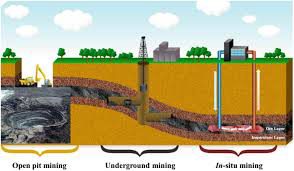
The US used to be the world’s largest uranium producer, although it produces de minimis volumes today. In 1980, the US produced 40 mm pounds of uranium, and many of these former operations remain fully permitted and are being rehabilitated. The first in-situ project—UR Energy’s Lost Creek, is scheduled to produce as soon as next year, although volumes will only be 2-3 mm lbs per year. Kazatomprom has announced it will increase production by 15 mm lbs next year, although G&RA staff are skeptical. A potential sulfuric acid bottleneck could likely make reaching their goal impossible. G&RA staff are trying to schedule a trip in 2024 to learn more and will report back. Adding to this supply, Paladin’s Langer Heinrich mine, long shut because of low prices, is scheduled to restart in 2024 and will add 6 mm lbs to 2024 uranium supply.
Although supply will ultimately undo the uranium rally, it will take years to ramp up, given years of chronic underinvestment in the industry. Prices will likely move much higher. G&RA predicts the following:
"As U.S. utility buyers realize that decades of ample secondary supply are gone, they will panic, scramble to secure volumes, and drive prices much higher. Eventually, they may be induced to approach the various financial vehicles, including the Sprott Physical Uranium Trust, to seek the uranium they need. Ultimately, they might be forced to pay large premiums to spot prices to secure long-term supply. We believe this will likely mark the top of the uranium bull market. This could be many years away; until then, we believe the uranium price rally will persist."
To download or revisit our entire Q3 2023 research letter, see (here).
Managed & Built by I2M Consulting, LLC | © 2010-
