

Singh and 9 co-authors reported early 2014 that uraninite (UO2) is the most desirable end product of in situ bioreduction because of its low solubility under reducing conditions. For effective long-term immobilization of uranium (U), there should be no biotic or abiotic reoxidation of the insoluble biogenic U(IV). 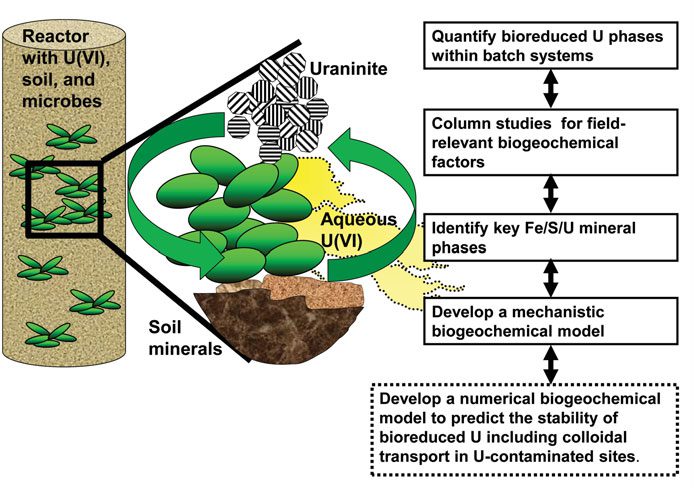 It is therefore critical to understand the long-term stability of U(IV) under oxic- and nutrient-limited conditions at U-contaminated subsurface sites. It has now been established that following in situ bioremediation of U(VI) via nutrient addition in the subsurface, a range of physical, chemical, and biological factors control the rate and extent of long-term stability of U(IV).
Some of these factors are tied to site specific conditions including existence of oxidants such as Fe(III)(hydr)oxides, Mn(IV) oxides, oxygen, and nitrate;
the presence of organic carbon and the reduced forms of U (e.g., mononuclear U(IV) or nanometer-sized uraninite particles); and the carbonate concentration and pH of groundwater.
The authors considered the contribution of these factors in controlling U(IV)- reoxidation, and highlights the competition among U(IV) and other electron acceptors and possible mechanisms of reoxidation of various forms of U(IV).
Managed & Built by I2M Consulting, LLC | © 2010-
