

NN reported on December 15 2023 that the U.S. Air Force Research Laboratory’s (AFRL) Space Vehicle Directorate has selected Westinghouse, Northrop Grumman, and Astrobotic for an advanced space research program that aims to power satellites with nuclear energy.

that could power a human settlement on the moon.
The award, which was announced by Westinghouse on December 12, supports the Joint Emergent Technology Supplying On-Orbit Nuclear Power (JETSON) program. The amount of the award was not disclosed by Westinghouse or on the AFRL website. NASA is also using nuclear to power internal systems and will one day to provide propulsion to spaceships.
Why nuclear?
The JETSON program is examining alternatives to current space power systems that consist of solar arrays, which require sunlight and frequent repositioning to function, and batteries, which can be heavy and have limited storage. According to Westinghouse, a nuclear reactor system provides constant power without these operational limitations, allowing for higher, more flexible, and reliable levels of power.
They said it:
“This award reflects the progress made in the development of our technology and demonstrates its unique capability to power the nation’s most critical missions,” said Jon Ball, president of eVinci Technologies at Westinghouse. “We are proud to be able to meet AFRL’s space nuclear power needs with our demonstrated technology.”
Scott Kugler, director of space vehicle programs at Northrop Grumman, said:
“Northrop Grumman will leverage its strong heritage in nuclear-electric power and propulsion to advance JETSON’s cutting-edge technology, working with Westinghouse, Astrobotic, and government partners to develop a new age of spacecraft systems that will help secure our nation’s freedom and advance human understanding of the universe.”
John Thornton, Astrobotic chief executive officer, noted,:
“Astrobotic is honored to support Westinghouse and their AFRL customer with adapting high-heritage terrestrial reactor technologies for space applications as part of our continued focus on advancing the state of the art for in-space power.”
Nuclear power in space is the use of nuclear power in outer space, typically either small fission systems or radioactive decay for electricity or heat. Another use is for scientific observation, as in a Mössbauer spectrometer.
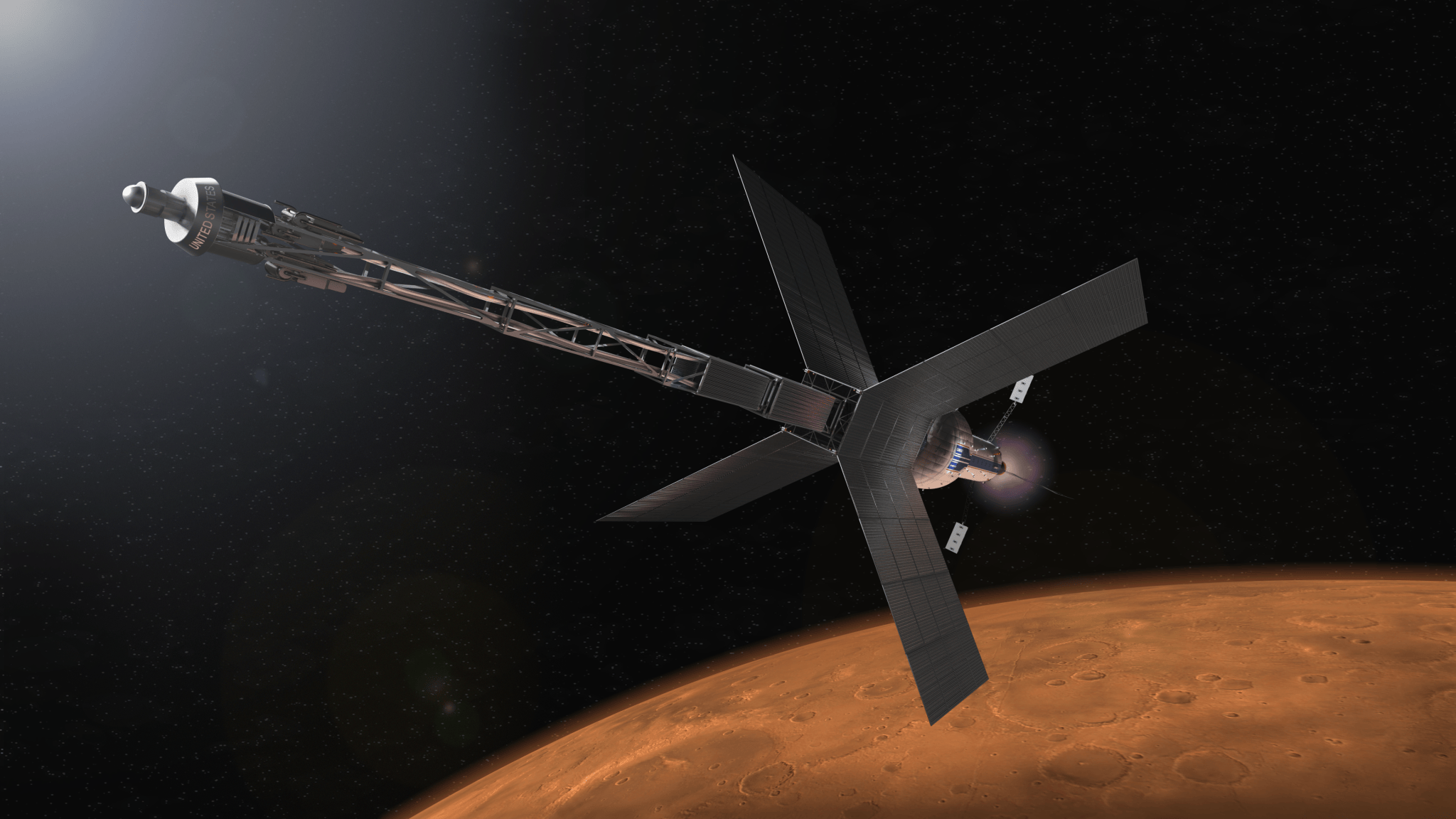 Transit habitat and nuclear electrical & propulsion systems that could one day take
astronauts to the solar system's planets and moons. Credits: NASA
Managed & Built by I2M Consulting, LLC | © 2010-
