

Abesser and 7 co-authors and contributors indicated in 2023 that this report is commissioned by the North East Local Enterprise Partnership (NE LEP) and funded by the Department for Energy Security and Net Zero (DESNZ) and the North East and Yorkshire Net Zero Hub. It aims to provide an evidence-based assessment and ‘case making’ document to help accelerate the development and deployment of deep geothermal energy projects in the UK.
This commission follows and is intended to complement the Mine Energy White Paper, led and procured by the NE LEP during 2020 and 2021, on behalf of the UK Mine Energy Taskforce.
This paper is supplemented by a more detailed report (referred to as the ‘full report’), which contains more detailed analysis of the geothermal landscape and provides the methodologies, data and references that have informed the development of this paper.
Geothermal energy is the energy generated and stored in the form of heat beneath the surface of the United Kingdom. It can provide an ultra-low-carbon source for heating, cooling and power generation. Exploitation of deep geothermal systems requires the drilling of deep wells to reach higher temperature
heat sources at depths of more than 500 meters. Although the geothermal energy potential is enormous, the current high costs of drilling restrict the economically viable exploitation of geothermal energy to areas with specific geological settings. As technologies improve and new extraction methods develop, the areas where geothermal exploitation is economically viable would increase.
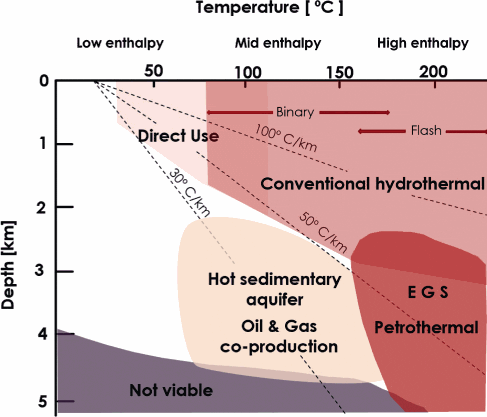
Most of the UK’s onshore deep geothermal potential is found in deep sedimentary basins that are dispersed across the UK (see Figure 1 in report). Deep sedimentary basins typically contain deeply buried limestones and sandstones. Where groundwater circulation occurs within the deeply buried rocks (> 500 meters), they form hydrothermal systems (also called deep geothermal aquifers or hot sedimentary aquifers).
Temperatures within these basins are estimated to be 40–60°C but could reach 100°C or more in some of the deepest parts. This temperature range makes these systems most suited for geothermal heating applications such as district heat networks, horticulture and industry. These hot sedimentary aquifers have large heat resources, but estimating the economically useable fraction of heat has not yet been possible as it requires more detailed knowledge of the deep subsurface that needs to be developed from targeted exploration (e.g., geophysical surveys, drilling of wells and project development).
In addition, granites found in Cornwall, the North of England, Scotland and Northern Ireland have also been identified as proved and potential geothermal targets for power and/or heat production. Indeed, the whole country has geothermal potential with the sedimentary basins and granites representing the more accessible portions of the national geothermal resource.
Deep geothermal projects progress through the project development stages summarized in Figure 2. Several deep geothermal projects are currently progressing in the UK and are at different stages of development.
Managed & Built by I2M Consulting, LLC | © 2010-
