

Hopkins reported in later November 2023 that detrital zircon (DZ), a tiny but invaluable occurrence of the mineral zircon, zirconium orthosilicate, plays a pivotal role in unraveling the geological history of many complex regions around the world. These minuscule crystals, often no larger than a grain of sand, hold within them a treasure trove of information about the Earth’s past.
 Detrital zircon grains of an igneous rock as seen through an incident light microscope.
Photo credit: Martin Lindner (Költringer, 2021).
Detrital zircons are primarily found in sedimentary rocks, and their age can be determined through radiometric dating techniques, an analytic method barely a century old that arose out of the discovery of radioactivity. This laboratory process is called detrital zircon geochronology. In the case of the Front Range of Colorado, these DZs provide crucial insight into the formation and evolution of the Rocky Mountains and the geological events that have shaped the state over billions of years.
DZs typically appear as small, elongated (tetragonal) crystals. These crystals are often prismatic or needle-like in shape and can vary in size, ranging from a fraction of a millimeter to a few millimeters in length. The color of DZ can vary, but it is commonly translucent to transparent, and the most common color is brown or reddish-brown. However, it can also appear in shades of yellow, gray, or even colorless. The mineral zircon itself is hard, dense, and often occurs with impurities of uranium and rare earth elements. It is used as a gemstone when found in suitable sizes and clarity and is found in a number of locations in Colorado including as large brown crystals in the Cheyenne Mining District in El Paso County.
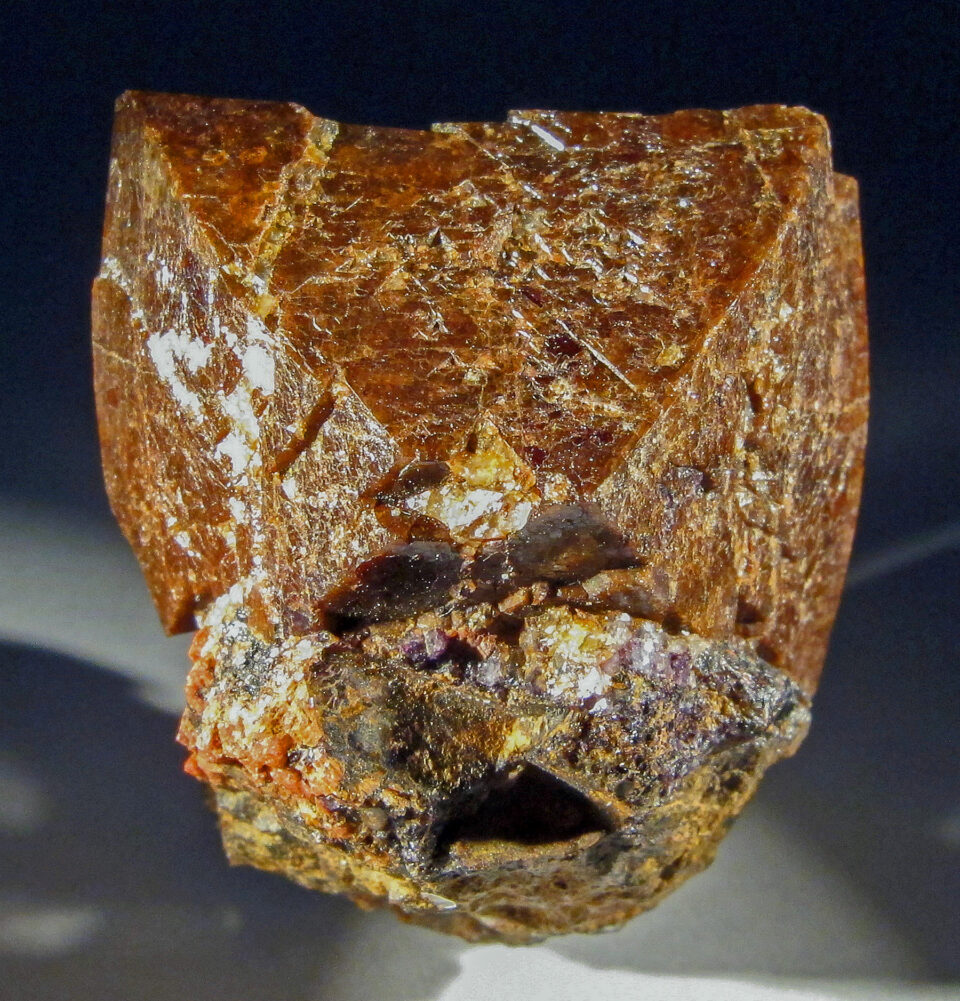 Zircon crystal on matrix, 26 x 21 x 20 mm., N. Cheyenne Cañon area,
El Paso County, Colorado. Photo credit: Kelly Nash.
One of the distinctive features of detrital zircon is its high resistance to weathering and erosion. This durability is one of the reasons why it is often found in sedimentary rocks, as it can survive the processes of transport and deposition. DZ crystals may have distinct facets and show various surface textures, including striations and growth patterns, which can be useful for identifying and characterizing them under a microscope.
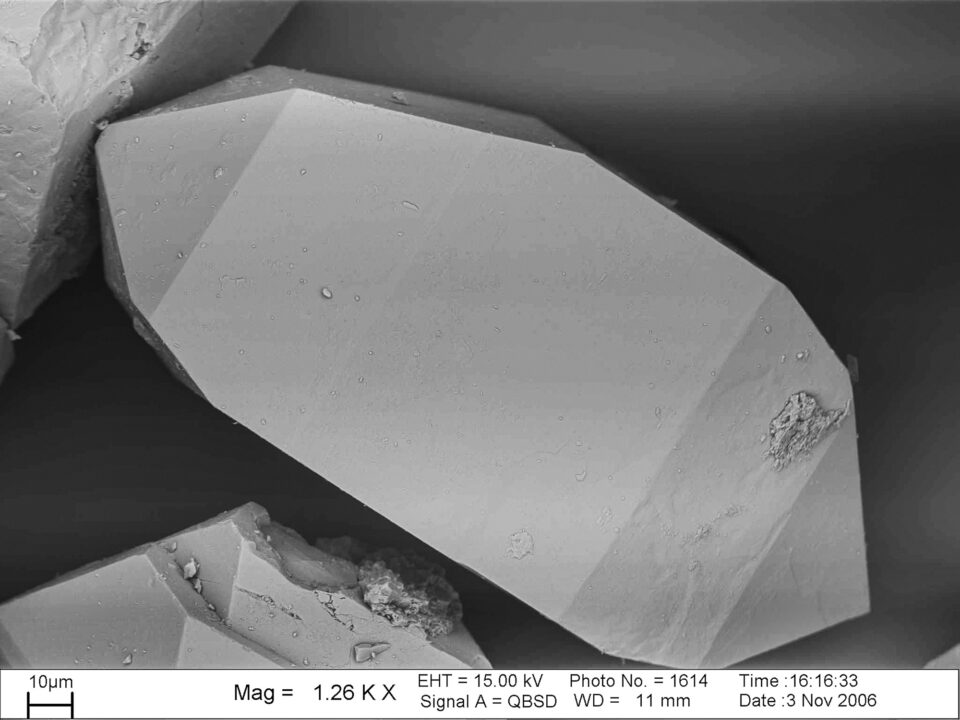 A single zircon crystal, exhibiting classic ditetragonal
dipyramidal form, through a scanning electron microscope.
Photo credit: Gunnar Ries, Wikimedia Commons.
When examining DZs through scanning electron microscopy, their internal structure and the presence of characteristic mineral inclusions or zoning patterns can provide valuable information for age dating and geological studies. Inconspicuous to the naked eye, DZ is extremely important to contemporary geoscience research through its ability to record geological history as deduced through radiometric dating and other analytical methods.
The Front Range of Colorado, known for its dramatic landscapes and rugged terrain, owes much of its geological complexity to the interactions of tectonic plates over tens of millions of years. DZ found in the sedimentary rocks of this region have revealed a diverse range of ages, spanning from the Proterozoic eon to the Cenozoic era. These zircons have been instrumental in identifying the timing of mountain-building events, such as the Laramide orogeny, which played a pivotal role in shaping the Rockies. They also help geologists trace the origins of the sediments that now constitute the Front Range, shedding light on the source areas and the ancient landscapes that once existed in this region.
Additionally, DZ provides clues about the climate, paleoenvironments, and the processes that led to the deposition of sediments in the Front Range. Through careful analysis of these minerals, CGS geoscientists can infer the types of rocks that once eroded and contributed to the formation of the sedimentary layers we see today. This information aids in reconstructing past ecosystems and understanding how geological forces and environmental changes have influenced the present-day topography and ecology of the state.
In summary, DZs are like time capsules, preserving critical aspects of Colorado’s geological history. Through their ages and origins, they offer insights into the ancient events and conditions that have shaped the region, enriching our understanding of its dynamic geological past.
Read on .....
On the occasion of releasing a new dataset: ON-004-04D Data tables of detrital zircon U-Pb geochronologic analyses and trace element concentrations of select Cretaceous, Paleogene, and Neogene rocks, Denver Basin and Northeastern Colorado (Data) – v20231110 that features data on 10 samples tested from a variety of locations around the Front Range region.]
Managed & Built by I2M Consulting, LLC | © 2010-
