

Kottlowski reported in 1979 that in 1947 the Royal Flush, Mex-Tex, and Portales mine adits in the Hansonburg mining district of Socorro County, central New Mexico, were opened based on surface outcrops of barite-galena-fluorite veins and then followed underground via adits, slope, and shafts, all under the shallow subsurface.
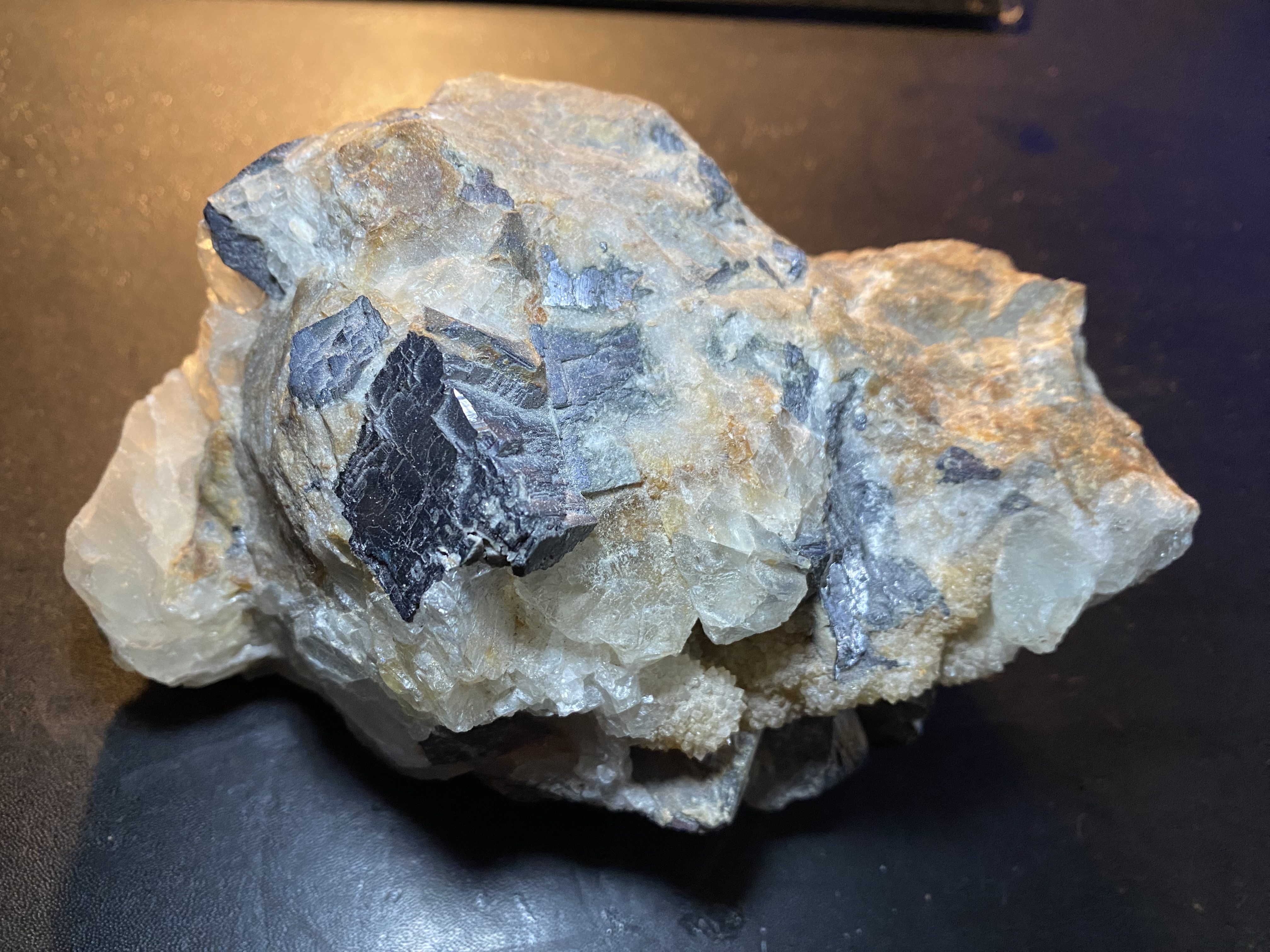 Sample of Ore from the Portales Mine in the Hansonburg Mining
District in New Mexico. Obtained by Michael D. Campbell during
a visit to the area (1976).
Photo by Michael D. Campbell from his report.
Through 1962 about 37,500 tons of barite, 5,800 tons of lead, and 1,870 lbs of silver were mined. When the rich pockets of ore apparently played out, the mines closed. Sporadic exploration during the past 20 years coupled with intensive geologic work in 1978 has now (1979) blocked out almost 1 million tons of ore.
To make this ore economically producible, properties were consolidated, a ground-water supply was developed in this arid area, exploration was geologically guided, and innovative crushing and concentrating equipment was designed. Previously, only barite and galena have been recovered; now fluorite also can be separated from the gangue of calcite and quartz.
The ore occurs as open-space filling of shatter zones in massive limestones, adjacent to faults, with local replacement of favorable strata. Rare minerals such as linarite and murdochite are present in the barite-fluorite-galena ores.
Kottlowski concluded in 1979 that although previous operations had obtained galena and barite concentrates from the ore, this had poor recovery of fluorite. In the future, The Hansonburg Mines, Inc. mill personnel plan to utilize two new processes, 1) a concentrating machine based mainly on gravity separation of the ore, and 2) an impact crusher to take the place of secondary crushing and grinding (Steensma, 1978).
With recovery of silver from the galena concentrates, the large amount of blocked-out ore, and with recovery of fluorite in addition to lead and
barite, this relatively small operation (of about 400 tons per day) should be economical to operate (after 1979).
Managed & Built by I2M Consulting, LLC | © 2010-
