

Ullah and 5 co-authors reported in 2020 that the Taunsa uranium occurrence like other uranium resources in Pakistan is hosted by the Late Miocene-Pliocene age Litra Formation of the Siwalik Group molasse sediments. Taunsa uranium prospect is a unique phreatic-type uranium resource in terms of its disturbed geological setting of the eastern limb of the Zindapir anticline in the eastern Sulaiman range.
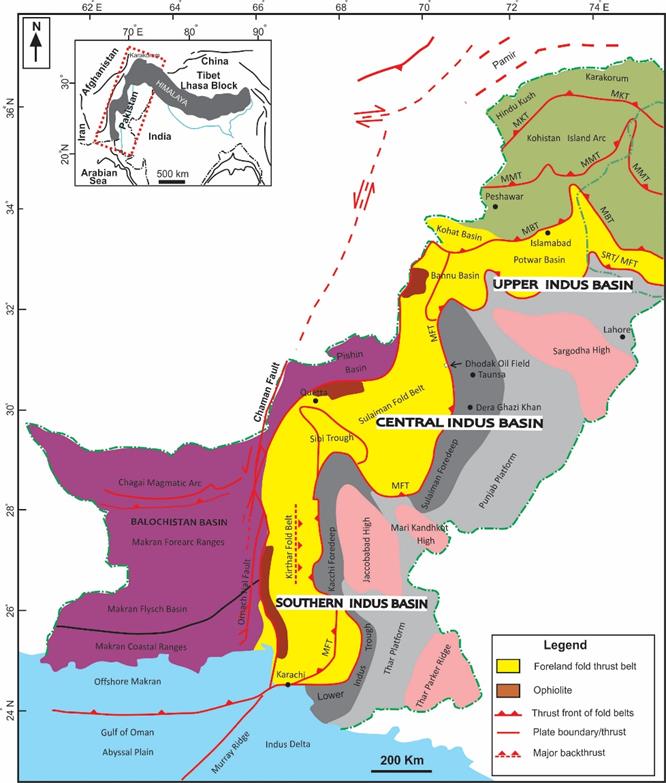 Tectonic and sedimentary basin map of Pakistan (modified after Aziz and
Khan, 2003). Inset shows the entire Himalayan Range (modified
from Najman, 2006). The dotted rectangle in the inset map is the Pakistani
terrain. MKT: Main Karakorum Thrust, MMT: Main Mantle Thrust, MCT:
Main Central Thrust, MBT: Main Boundary Thrust, SRT; Salt Range Thrust,
MFT: Main Frontal Thrust.
Autoradiography technique was used to locate the spots of anomalous uranium concentration in thin sections from ore of Taunsa prospect. Twenty polished thin sections from uranium ore ranging from 200 ppm to 600 ppm were attached to detectors for a month which produced prominent alpha track which were used to find the traps of uranium.
Subsequently, these spots were studied under SEM and EPMA for further investigations of uranium phases. Autoradiography revealed that Taunsa uranium ore is mostly associated with organic matter (probably petroleum), black shale clasts, biotite, fougerite (a green colour rusty mineral) and with micritic clasts.
The authors concluded that prospective facies of the host sandstone containing relatively abundant black shale clasts, organic matter and biotite may be targets for exploratory drilling in Taunsa uranium deposit and its extensions in the eastern limb of Zindapir anticline. Autoradiography in low grade ore samples from Taunsa uranium prospect helped to delineate uranium traps which include organic matter, black shale clasts, biotite, fougerite and micrite.
The organic matter seems to be humate (structureless organic matter) and is related possibly to hydrocarbons sourced from the older marine black shales of the Sulaiman range. Uranium trapped in black shale clasts seems to be mainly epigenetic. Biotite and a green rusty mineral (fougerite) are also uranium traps probably due to reductive character of the ferrous iron in their structure. The organic matter in micritic limestone fragments may have trapped uranium.
Managed & Built by I2M Consulting, LLC | © 2010-
