

Williams reported in Part 1 in early November 2023 of his discussions regarding how advanced civilizations might have gone extinct, or they might evolve in the distant future sometime. Both of these possibilities could be why we haven't heard from any!
 Full-sky view of the Milky Way Galaxy and neighboring galaxies from the
Gaia Space Observatory. ESA/Gaia/DPAC
Issues Discussed:
- Decades later, the Drake Equation is still foundational to the Search for Extraterrestrial Intelligence.
- According to Drake, the longevity of a civilization (L) was the most important parameter.
- But does longevity mean how long a species has before going extinct, or could there be another interpretation?
Find out in this two-part series.
On September 2nd, 2022, the world said goodbye to one of the most famous astronomers and theoreticians of the past century when Dr. Frank Donald Drake passed away at the age of 92. Known as the “father of SETI,” Drake was a lifelong member of the National Radio Astronomy Observatory (NRAO) and a pioneer in the emergence of the Search for Extraterrestrial Intelligence (SETI) as a scientific discipline during the latter half of the 20th century.
In addition to mounting what is regarded as the first-ever SETI experiment (Project Ozma), he was integral to the most well-known attempt at Messaging Extraterrestrial Intelligence (METI) – the Arecibo Message. But, arguably, Drake is remembered most for the equation that bears his name - i.e., the Drake Equation.
Drake presented his famous equation in 1961 in preparation for the SETI meeting hosted by the NRAO at the Greenbank Observatory. Intended as a probabilistic argument and thought experiment, the equation summarized the challenges of communicating with extraterrestrial intelligence (ETI) in our galaxy. Like the Fermi Paradox and the Kardashev Scale, this equation remains foundational to SETI efforts to this day.
The Drake equation
According to the Drake Equation, the number of civilizations in the Milky Way that humanity could communicate with (N) could be calculated by multiplying the rate of star formation (R*), the fraction of stars that have planets (fP), the mean number of planets that could support life (ne), the fraction of habitable planets that develop life (fe), the fraction of planets with life where life develops intelligence (fi), the fraction of intelligent civilizations that develop transmission technologies (fc), and the mean length of time that civilizations can communicate (L).
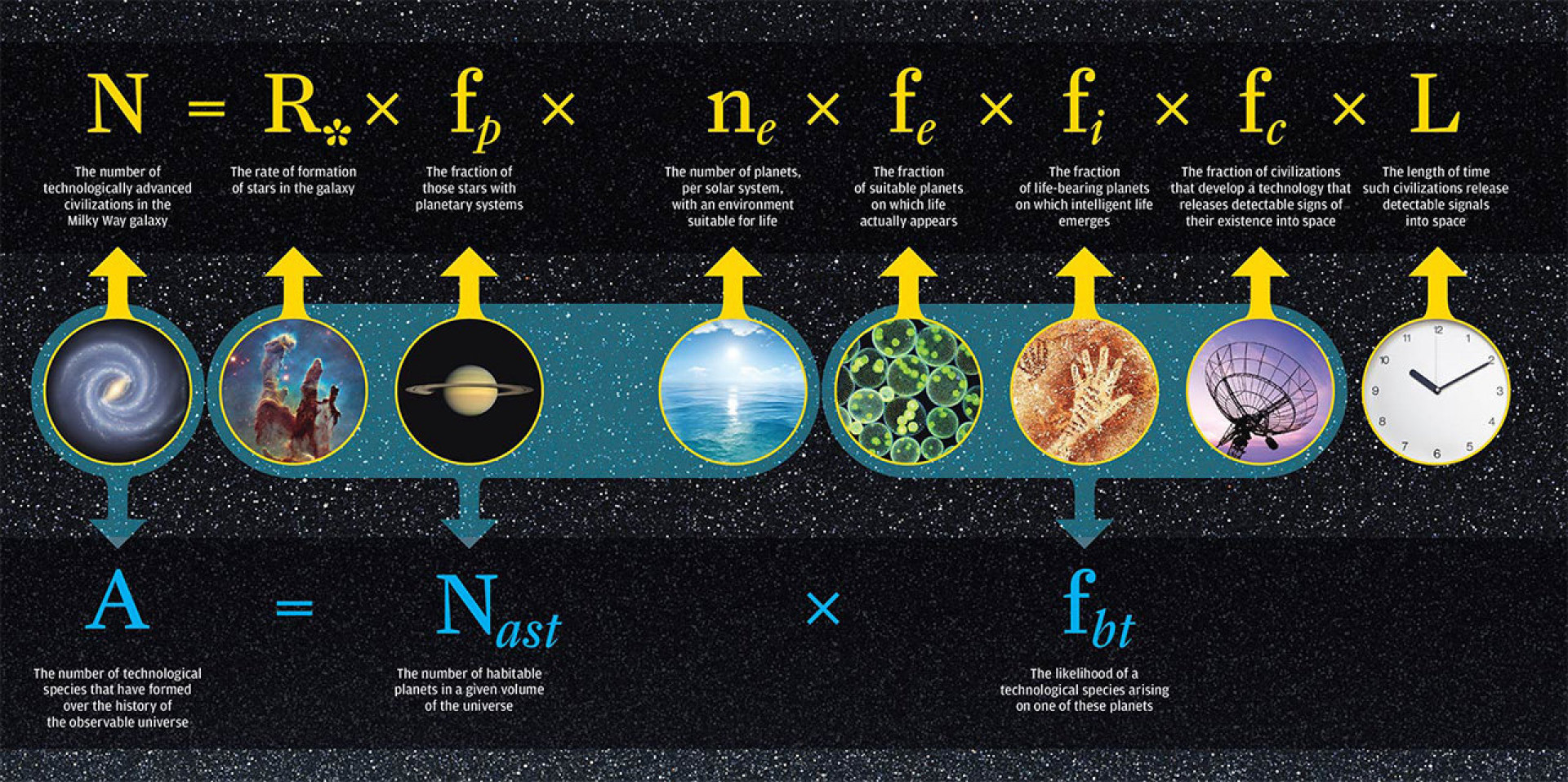
The Drake Equation
NASA
It turns out that including this last parameter had significant implications that went beyond the field of SETI research. The L parameter encapsulated the growing existential fears of the 1960s, characterized by the potential for nuclear war and growing environmental awareness. By suggesting that ETIs have a limited communication window, Drake effectively said that human civilization also had a finite lifespan.
Dr. Drake is said to have considered this parameter the most important variable in his equation, partly because it is the most difficult to constrain. As he indicated in an interview with the SETI Institute in 2012:
“The accuracy of its result, which is a prediction of the number of detectable civilizations in the galaxy, is actually dependent on the factor that is least well-known. And unfortunately, that one - which is the longevity of civilizations in a detectable state - is still unknown and will be until we detect other civilizations.”
However, there are several ways to interpret the L parameter. As the history of SETI demonstrates, our speculations regarding extraterrestrial civilizations reflect how we view ourselves, our existential fears, and our predictions about our future development.
The first SETI experiment
In 1960, Frank Drake and his colleagues at the National Radio Astronomy Observatory (NRAO) conducted Project Ozma, which is generally considered the first SETI project. Between April and July 1960, they used the Green Bank Observatory's 85-foot antenna to monitor two nearby Sun-like stars - Tau Ceti and Epsilon Eridani - for six hours daily.
While Project Ozma is generally regarded as the first SETI project, there were historical antecedents. These included the experiments of early radio pioneers like Guglielmo Marconi, Thomas Edison, and Nikolai Tesla. Then there were Percival Lowell’s telescopic observations of Mars in the late 19th and early 20th centuries in search of "canals" and the campaign led by American astronomer David Peck Todd and the U.S. Naval Observatory in August of 1924 ("National Radio Silence Day"). However, these and other experiments were all directed toward finding extraterrestrial intelligence in the Solar System (mainly on Mars).
Project Ozma is regarded as the first SETI experiment because it shifted the character of the field of study. As science historian Rebecca Charbonneau argues, the timing of Ozma set it apart from previous experiments and established it as the first “true” SETI experiment. In short, it was a change in thinking, not ideas or tools, that came from the Cold War and the early days of the Space Race.
Read on.....great article.
Don't forget Part 2 of this article.
Managed & Built by I2M Consulting, LLC | © 2010-
