
Wilcox reported in late October 2023 that at Johnson Space Center (JSC), in a specially constructed clean room, a curation team works through challenges this fall to meticulously disassemble a container over-filled with some of the most precious material on Earth—regolith samples collected from the surface of a rare carbonaceous asteroid thought to be 4.5 billion years old.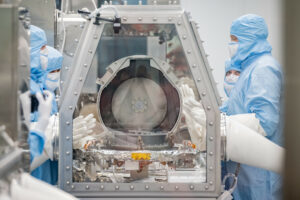 OSIRIS REx Asteroid Sample Return lid opening at Building 31
Astromaterials Curation Facility. Photo Credit: Robert Markowitz
The asteroid, Bennu, was millions of miles from Earth when the OSIRIS-REx spacecraft captured the sample in its Touch and Go Sample Acquisition Mechanism (TAGSAM). That TAGSAM is now contained within a glovebox in the clean room. On October 20, NASA announced that the team has removed 70.3 grams of rocks and dust from TAGSAM, well beyond the goal of 60 grams when the mission launched, with more to remove.
“As you can imagine, working with hands inside of a glove box within a clean lab is hard, challenging work, and it does not go quickly, but we need to do this right,” said Francis McCubbin, NASA’s Astromaterials Curator in the Astromaterials Research and Exploration Science (ARES) Division. “And in fact, we have a lot of heritage of this working really well to keep samples pristine over multi-decadal timescales.”
The 70.3 grams already secured includes rocks and dust that were found outside the sampler head. Bennu is a rubble pile asteroid with an unexpectedly rugged surface. After spending months developing plans to work around large hills and boulders on the surface to collect from a site that was much smaller than the team had initially prepared for, Bennu yielded abundant regolith when the TAGSAM touched the asteroid’s rough surface for about six seconds. So much regolith, in fact, it prevented a mylar flap from fully closing to secure the sample.
“Just a couple days after we collected the sample, we saw material spewing out into outer space. One of the many heart-pounding moments on this mission for me. It’s because large particles got trapped in between this flap, which was designed to keep the precious sample inside. And that’s generally good news, right? Because those are big particles and there’s a lot of science to be done there,” said Dante Lauretta, OSIRIS-REx principal investigator, speaking at a recent NASA press conference.
At Johnson Space Center (JSC), in a specially constructed clean room, a curation team works through challenges this fall to meticulously disassemble a container over-filled with some of the most precious material on Earth—regolith samples collected from the surface of a rare carbonaceous asteroid thought to be 4.5 billion years old.
The asteroid, Bennu, was millions of miles from Earth when the OSIRIS-REx spacecraft captured the sample in its Touch and Go Sample Acquisition Mechanism (TAGSAM). That TAGSAM is now contained within a glovebox in the clean room. On October 20, NASA announced that the team has removed 70.3 grams of rocks and dust from TAGSAM, well beyond the goal of 60 grams when the mission launched, with more to remove.
OSIRIS REx Asteroid Sample Return lid opening at Building 31 Astromaterials Curation Facility.
Photo Credit: Robert Markowitz
“As you can imagine, working with hands inside of a glove box within a clean lab is hard, challenging work, and it does not go quickly, but we need to do this right,” said Francis McCubbin, NASA’s Astromaterials Curator in the Astromaterials Research and Exploration Science (ARES) Division. “And in fact, we have a lot of heritage of this working really well to keep samples pristine over multi-decadal timescales.”
The 70.3 grams already secured includes rocks and dust that were found outside the sampler head. Bennu is a rubble pile asteroid with an unexpectedly rugged surface. After spending months developing plans to work around large hills and boulders on the surface to collect from a site that was much smaller than the team had initially prepared for, Bennu yielded abundant regolith when the TAGSAM touched the asteroid’s rough surface for about six seconds. So much regolith, in fact, it prevented a mylar flap from fully closing to secure the sample.
“Just a couple days after we collected the sample, we saw material spewing out into outer space. One of the many heart-pounding moments on this mission for me. It’s because large particles got trapped in between this flap, which was designed to keep the precious sample inside. And that’s generally good news, right? Because those are big particles and there’s a lot of science to be done there,” said Dante Lauretta, OSIRIS-REx principal investigator, speaking at a recent NASA press conference.
Asteroid particles coat the base of the OSIRIS-REx science canister. Some of the first material gathered after the sample arrived in the clean room at JSC has been examined under an electron microscope and the results are intriguing. The sample contains water-bearing clay minerals and abundant carbon—about 4.7 percent by weight. Water and carbon are two key elements of life. Evidence indicates that asteroids crashing into Earth in the early, chaotic solar system could have delivered key compounds as life was starting to emerge.
“The reason that Earth is a habitable world, that we have oceans and lakes and rivers and rain, is because these clay minerals … like the ones we’re seeing from Bennu, landed on Earth four billion years ago to four and a half billion years ago, making our world habitable. So, we’re seeing the way that water got incorporated into solid material and then ultimately into planets. And not just Earth, but probably Venus and Mars also had abundant water as well,” Lauretta said.
At Johnson Space Center (JSC), in a specially constructed clean room, a curation team works through challenges this fall to meticulously disassemble a container over-filled with some of the most precious material on Earth—regolith samples collected from the surface of a rare carbonaceous asteroid thought to be 4.5 billion years old.
The asteroid, Bennu, was millions of miles from Earth when the OSIRIS-REx spacecraft captured the sample in its Touch and Go Sample Acquisition Mechanism (TAGSAM). That TAGSAM is now contained within a glovebox in the clean room. On October 20, NASA announced that the team has removed 70.3 grams of rocks and dust from TAGSAM, well beyond the goal of 60 grams when the mission launched, with more to remove.
“As you can imagine, working with hands inside of a glove box within a clean lab is hard, challenging work, and it does not go quickly, but we need to do this right,” said Francis McCubbin, NASA’s Astromaterials Curator in the Astromaterials Research and Exploration Science (ARES) Division. “And in fact, we have a lot of heritage of this working really well to keep samples pristine over multi-decadal timescales.”
The 70.3 grams already secured includes rocks and dust that were found outside the sampler head. Bennu is a rubble pile asteroid with an unexpectedly rugged surface. After spending months developing plans to work around large hills and boulders on the surface to collect from a site that was much smaller than the team had initially prepared for, Bennu yielded abundant regolith when the TAGSAM touched the asteroid’s rough surface for about six seconds. So much regolith, in fact, it prevented a mylar flap from fully closing to secure the sample.
“Just a couple days after we collected the sample, we saw material spewing out into outer space. One of the many heart-pounding moments on this mission for me. It’s because large particles got trapped in between this flap, which was designed to keep the precious sample inside. And that’s generally good news, right? Because those are big particles and there’s a lot of science to be done there,” said Dante Lauretta, OSIRIS-REx principal investigator, speaking at a recent NASA press conference.
Some of the first material gathered after the sample arrived in the clean room at JSC has been examined under an electron microscope and the results are intriguing. The sample contains water-bearing clay minerals and abundant carbon—about 4.7 percent by weight. Water and carbon are two key elements of life. Evidence indicates that asteroids crashing into Earth in the early, chaotic solar system could have delivered key compounds as life was starting to emerge.
“The reason that Earth is a habitable world, that we have oceans and lakes and rivers and rain, is because these clay minerals … like the ones we’re seeing from Bennu, landed on Earth four billion years ago to four and a half billion years ago, making our world habitable. So, we’re seeing the way that water got incorporated into solid material and then ultimately into planets. And not just Earth, but probably Venus and Mars also had abundant water as well,” Lauretta said.
“I mean, there were scientists on the team going, ‘Wow!’ And when scientists say ‘wow,’ that’s a big deal.”
The high concentration of carbon, a measurement made by the Carnegie Institution for Science, excited the team, according to NASA astrobiologist Dr. Daniel Glavin, a co-Investigator who leads the OSIRIS-REx sample analysis team.
“I mean, there were scientists on the team going, ‘Wow!’ And when scientists say ‘wow,’ that’s a big deal,” Glavin said, speaking at the press conference. “In fact, Carnegie said [of] the extra-terrestrial samples they’ve analyzed, this is the highest abundance of carbon they’ve ever measured. They’ve analyzed close to 250 meteorites. So, this is a unique sample that we’re dealing with.”
As tantalizing as the sample is, it has proven difficult to fully access. As of late October, the curation team has been unable to remove the final two of 35 fasteners holding the TAGSAM head closed using tools approved for the procedure.
“The team has been working to develop and implement new approaches to extract the material inside the head, while continuing to keep the sample safe and pristine,” according to a NASA blog post. “While the procedure to access the final portion of the material is being developed, the team has removed the TAGSAM head from the active flow of nitrogen in the glovebox and stored it in its transfer container, sealed with an O-ring and surrounded by a sealed Teflon bag to make sure the sample is kept safe in a stable, nitrogen-rich, environment.”
Once the full sample is collected, the curation team and the science team will work closely together to develop a sample catalog that scientists around the world can use to request material to study Bennu in their own labs. The bulk of the sample, about 70 percent, will be preserved at JSC.
“The carbon and water molecules are exactly the kinds of material that we wanted to find,” said Bill Nelson, NASA administrator, speaking at the press conference. “They’re crucial elements in the formation of our own planet, and they’re going to help us determine the origin of elements that could have led to life.”
A status report of arriving at Bennu from Wilcox: 2018:
NASA’s OSIRIS-REx spacecraft has now reached Bennu, an asteroid roughly 0.3 miles in diameter, which has 1-in-2,800 odds of impacting Earth between 2175–2199. The spacecraft is performing a series of flybys over the asteroid’s poles and equator, coming as close as 4.4 miles. This survey will enable scientists to more accurately determine the asteroid’s mass.
Understanding the asteroid’s mass is important because the team needs to know Bennu’s gravitational pull before they insert Osiris-REx into orbit around it on December 31. It is the smallest object NASA has ever attempted to orbit. Already, OSIRIS-REx spectrometers have sent back valuable data indicating there are hydroxyls—molecules that contain oxygen and hydrogen atoms bonded together—that exist in clay minerals throughout the asteroid. This likely indicates that Bennu was once part of a larger asteroid that contained liquid water.
“The presence of hydrated minerals across the asteroid confirms that Bennu, a remnant from early in the formation of the solar system, is an excellent specimen for the OSIRIS-REx mission to study the composition of primitive volatiles and organics,” said Amy Simon, OVIRS deputy instrument scientist at NASA’s Goddard Space Flight Center in Greenbelt, Maryland.
After orbiting Bennu, the team will select a sample site and the spacecraft will briefly make contact via a sampling arm, which will touch the surface and release a burst of nitrogen gas. This will loosen and raise rocks and surface material, which will be captured in a sampler head. The spacecraft can make three collection attempts and can capture 2,000 grams of material. The spacecraft’s Sample Return Capsule (SRC) will return the sample to Earth, landing in the Utah desert.
“When samples of this material are returned by the mission to Earth in 2023, scientists will receive a treasure trove of new information about the history and evolution of our solar system,” said Simon
The Cost of the samples (here).
For a 2023 update: "Seeing NASA's OSIRIS-REx asteroid sample up close at the Smithsonian was surreal" (here).
Managed & Built by I2M Consulting, LLC | © 2010-