

Waldek reported in early October, 2023 that just as the sea ice around Antarctica grows and retreats each year, so does the ozone hole above the continent. And this year, that hole has grown a lot. 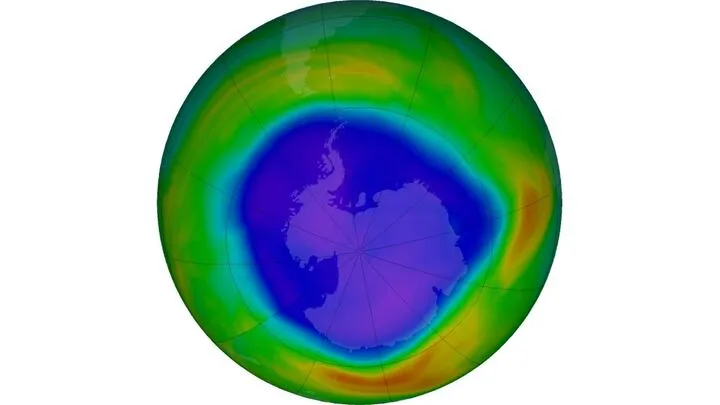 A map of the ozone hole on Sept. 16, 2023. (Image credit: NASA Ozone Watch)
Observations from the European Space Agency's (ESA) Copernicus Sentinel-5P satellite indicate the ozone hole reached approximately 10 million square miles (26 million square kilometers) in area on Sept. 16, 2023 — making it one of the largest seasonal holes ever observed. The true largest ozone hole maximum occurred in 2000, when the chasm reached nearly 11 million square miles (28.4 million square kilometers) in area.
Ozone is a naturally occurring gas, and there's a layer of it in the stratosphere that protects us from the sun's ultraviolet, or UV, rays. In 1985, a hole in the ozone layer was discovered above Antarctica — and later connected to human use of carbon-depleting substances. Since then, we've banned the use of those substances and have been monitoring the hole's size.
The ozone hole above Antarctica opened early this year. Huge Tonga undersea volcano eruption may be to blame. The ozone hole still grows and shrinks seasonally, however, due to temperature changes and wind conditions in the stratosphere, reaching a maximum between mid-September and mid-October.
"Our operational ozone monitoring and forecasting service shows that the 2023 ozone hole got off to an early start and has grown rapidly since mid-August," Antje Inness, Copernicus Atmosphere Monitoring Service senior scientist, said in a statement.
One possible reason for the higher-than-normal growth is the Hunga Tonga volcanic eruption in January 2022, which introduced massive quantities of water vapor into the air.
“The water vapor could have led to the heightened formation of polar stratospheric clouds, where chlorofluorocarbons (CFCs) can react and accelerate ozone depletion," said Inness.
Yet despite experiencing large seasonal growth this year, the ozone hole is still decreasing in size overall. "Based on the Montreal Protocol and the decrease of anthropogenic ozone-depleting substances, scientists currently predict that the global ozone layer will reach its normal state again by around 2050," said Claus Zehner, ESA's mission manager for Copernicus Sentinel-5P.
Managed & Built by I2M Consulting, LLC | © 2010-
