

WoldeGabriel, and 15 co-authors reported in 2014 that in-situ recovery (ISR) of uranium (U) from sandstone-type roll-front deposits is a technology that involves the injection of solutions that consist of groundwater fortified with oxygen and carbonate to promote the oxidative dissolution of U,which is pumped to recovery facilities located at the surface that capture the dissolved U and recycle the treated water.
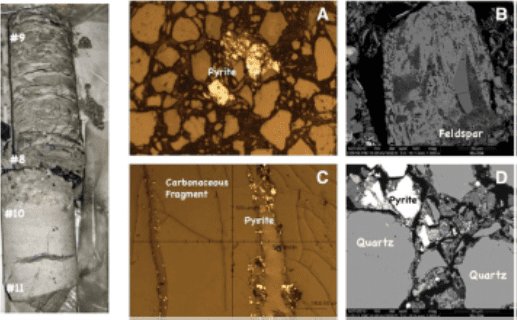 A core with organic-rich (#8 and 9) and arkosic sandstone (#10 and 11)
is shown on the left. Petrographic (A and C) and SEM (B and D) images
of selected thin sections from organic-rich 769 dark (C) and organic-poor
782c (A, B, and D) of post-ISR-mined cores from MU-4 ore zone collected
at depths of 237.6 m and 238.4 m, respectively.
The ISR process alters the geochemical conditions in the subsurface creating conditions that are more favorable to the migration of uranium and other metals associatedwith the uranium deposit. There is a lack of clear understanding of the impact of ISR mining on the aquifer and host rocks of the post-mined site and the fate of residual U and other metals within the mined ore zone. The authors performed detailed petrographic, mineralogical, and geochemical analyses of several samples taken from about 7 meters of core of the formerly the ISR-mined Smith Ranch–Highland uranium deposit in Wyoming.
The authors reported that previously mined cores contain significant residual uranium(U) present as coatings on pyrite and carbonaceous fragments. Coffinite was identified in three samples. Core samples with higher organic (N1 wt.%) and clay (N6–17 wt.%) contents yielded higher 234U/238U activity ratios (1.0–1.48) than those with lower organic and clay fractions.
The ISR mining was inefficient in mobilizing U from the carbonaceous materials, which retained considerable U concentrations (374–11,534 ppm). This is in contrast with the deeper part of the ore zone, which was highly depleted in U and had very low 234U/238U activity ratios. This probably is due to greater contact with the lixiviant (leaching solution) during ISR mining.
EXAFS analyses performed on grains with the highest U and Fe concentrations reveal that Fe is present in a reduced form as pyrite and U occurs mostly as U(IV) complexed by organic matter or as U(IV) phases of carbonate complexes. Moreover, U–O distances of ~2.05 Å were noted, indicating the potential formation of other poorly defined U(IV/VI) species. They also noted a small contribution from U_O at 1.79 Å, which indicates that U is partially oxidized. There is no apparent U–S or U–Fe interaction in any of the U spectra analyzed. However, SEM analysis of thin sections prepared from the same core material reveals surficial U associated with pyrite, which is probably a minor fraction of the total U present as thin coatings on the surface of pyrite.
The authors show the presence of different structurally variable uranium forms associated with the mined cores. U associated with carbonaceous materials is probably from the original U mobilization that accumulated in the organic matter-rich areas under reducing conditions during shallow burial diagenesis. U associated with pyrite represents a small fraction of the total U and was likely deposited as a result of chemical reduction by pyrite.
Their data suggest that areas rich in carbonaceous materials had limited exposure to the lixiviant solution, continue to be reducing, and still hold significant U resources. Because of their limited access to fluid flow, these areas might not contribute significantly to post-mining U release or attenuation. Areas with pyrite that are accessible to fluids seem to be more reactive and could act as reductants and facilitate U reduction and accumulation, limiting its migration.
Original working URL: https://www.i2mconsultants.com/downloads/corp/Characterization_of_cores_from_an_in_sit.pdf
Managed & Built by I2M Consulting, LLC | © 2010-
