

Klein and 5 co-authors reported in early 2023 that they have found a new way to switch superconductivity on and off in magic-angle graphene. This figure shows a device with two graphene layers in the middle (in dark gray and in inset). The graphene layers are sandwiched in between boron nitride layers (in blue and purple). The angle and alignment of each layer enables the researchers to turn superconductivity on and off in graphene with a short electric pulse.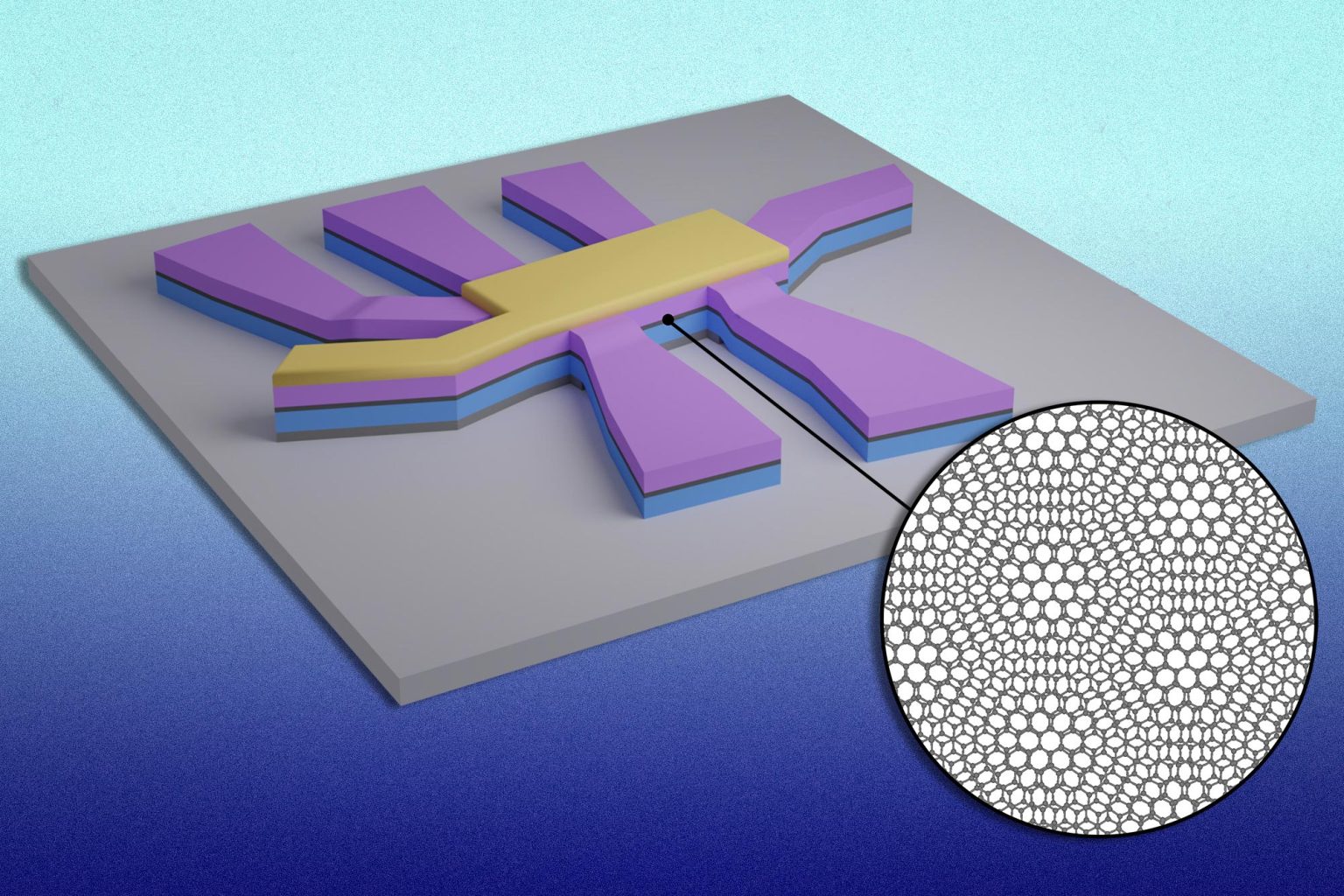
Applying a quick electric pulse completely flips the material’s electronic properties, opening a route to ultrafast, brain-inspired, superconducting electronics. MIT physicists have revealed a new and exotic property in “magic-angle” graphene: superconductivity that can be turned on and off with an electric pulse, much like a light switch. To accomplish this, they used some meticulous twisting and stacking of layers of graphene and boron nitride.
The discovery could lead to ultrafast, energy-efficient superconducting transistors for neuromorphic devices — electronics designed to operate in a way similar to the rapid on/off firing of neurons in the human brain. Magic-angle graphene refers to a very particular stacking of graphene — an atom-thin material made from carbon atoms that are linked in a hexagonal pattern resembling chicken wire. When one sheet of graphene is stacked atop a second sheet at a precise “magic” angle, the twisted structure creates a slightly offset “moiré” pattern, or superlattice, that is able to support a host of surprising electronic behaviors.
In 2018, Pablo Jarillo-Herrero and his group at MIT were the first to demonstrate magic-angle twisted bilayer graphene. They showed that the new bilayer structure could behave as an insulator, much like wood, when they applied a certain continuous electric field. When they upped the field, the insulator suddenly morphed into a superconductor, allowing electrons to flow, friction-free.
That discovery was a watershed in the field of “twistronics,” which explores how certain electronic properties emerge from the twisting and layering of two-dimensional materials. Researchers including Jarillo-Herrero have continued to reveal surprising properties in magic-angle graphene, including various ways to switch the material between different electronic states. So far, such “switches” have acted more like dimmers, in that researchers must continuously apply an electric or magnetic field to turn on superconductivity, and keep it on.
Now Jarillo-Herrero and his team have shown that superconductivity in magic-angle graphene can be switched on, and kept on, with just a short pulse rather than a continuous electric field. The key, they found, was a combination of twisting and stacking.
In a paper published on January 30 in the journal Nature Nanotechnology, the team reports that, by stacking magic-angle graphene between two offset layers of boron nitride — a two-dimensional insulating material — the unique alignment of the sandwich structure enabled the researchers to turn graphene’s superconductivity on and off with a short electric pulse.
“For the vast majority of materials, if you remove the electric field, zzzzip, the electric state is gone,” says Jarillo-Herrero, who is the Cecil and Ida Green Professor of Physics at MIT. “This is the first time that a superconducting material has been made that can be electrically switched on and off, abruptly. This could pave the way for a new generation of twisted, graphene-based superconducting electronics.”
His MIT co-authors are lead author Dahlia Klein PhD ’21, graduate student Li-Qiao Xia, and former postdoc David MacNeill, along with Kenji Watanabe and Takashi Taniguchi of the National Institute for Materials Science in Japan.
Read on ..., especially the additional reports on the use of graphene in the article below.
Managed & Built by I2M Consulting, LLC | © 2010-
