

Fleck reported on June 30, 2023 that on today's World Asteroid Day, fascination is mixing with fear when considering the latest and upcoming asteroid flybys. According to NASA's Center for Near Earth Object Studies, a number of asteroids have already passed by a little too close for comfort this year. The colossal 2005 YY128, which flew by the Earth on February 16, had a maximum possible diameter of more than 1,000 meters (0.6 miles).
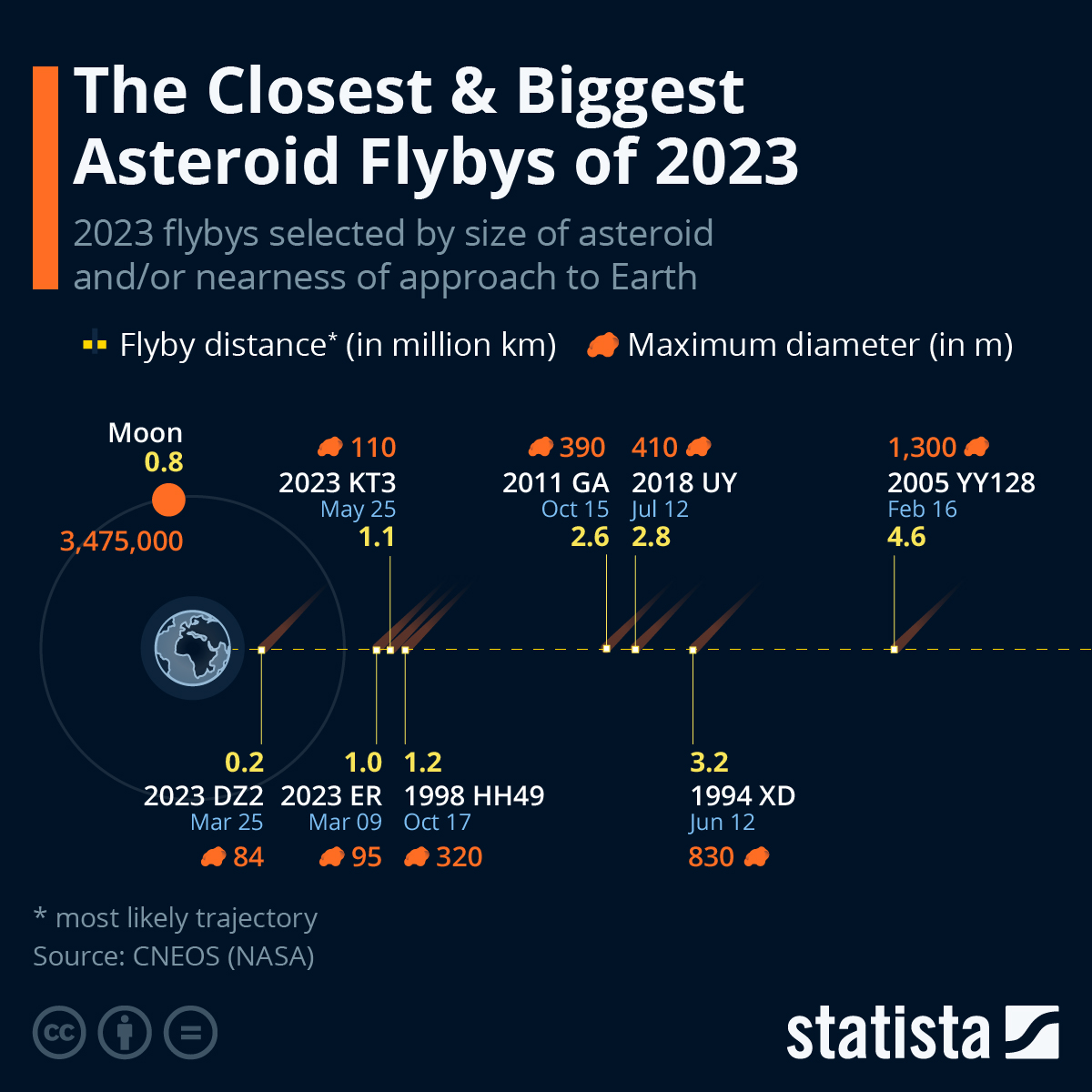 Because of its size, 2005 YY128 was already discovered in 2005 - as denoted in its name.
In recent years, scientists have been discovering more and more so-called Near Earth Asteroids, including many smaller ones. Despite their comparatively smaller size, these asteroids could still cause considerable damage if they collided with Earth. 2023 DZ2 (nicknamed “Dizzy”), passed by Earth on March 25, and came so close that it could be seen with a telescope and even binoculars.
The Largest Asteroid Craters on Earth
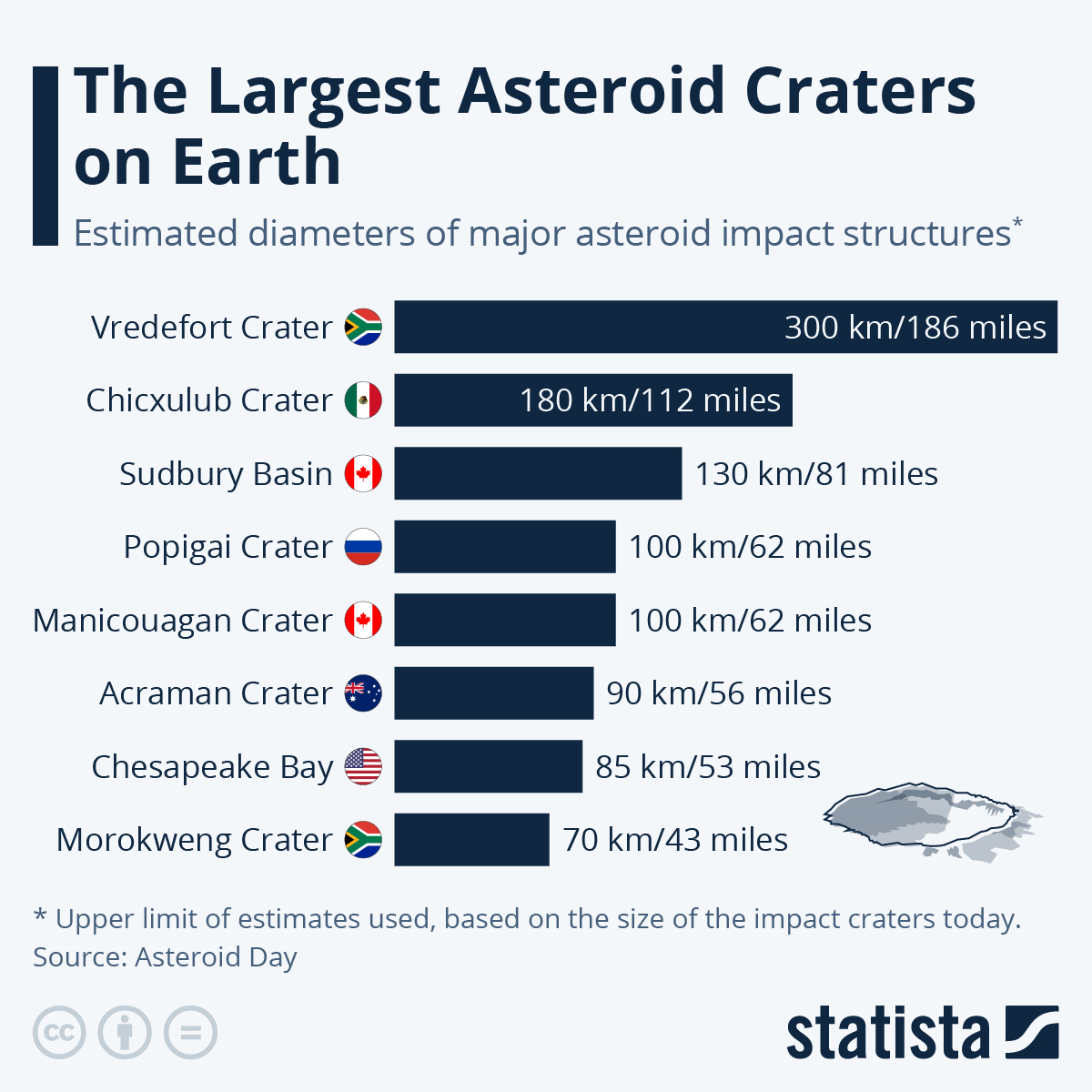
une 30 marks Asteroid Day, a day dedicated by the United Nations to raising awareness around the risks of asteroid impacts. The following Statista chart uses estimates from the Asteroid Foundation’s Asteroid Day portal to provide a round up of eight of the largest known asteroid impact craters on Earth.
First on the list - and the largest - is the Vredefort Crater, located not far from Johannesburg in South Africa. The crater was formed an estimated two billion years ago and today has an estimated diameter of some 300km.
Next up, is the Chicxulub Crater, located in the Yucatán Peninsula of Mexico. The Chicxulub impactor, as the asteroid that created it was known, is presumed to have wiped out the dinosaurs some 66 million years ago. The asteroid itself is thought to have been approximately 10 km in diameter and today its impact crater is approximately 180 km across.
The Popigai Crater in northern Siberia, Russia was created some 35 million years ago and today has a diameter of approximately 100 km. According to Asteroid Day, the area is now rich in diamond reserves thanks to the region having been heavy in carbon, which turned into the precious stone under the heat and pressure of the impact.
Three major impact craters in North America also make it onto the list: two in Canada (the Sudbury Basin in Ontario and the Manicouagan Crater in Québec) as well as one in the United States (Chesapeake Bay in Virginia). The latter is considered one of the best-preserved “wet-target” or marine impact craters worldwide.
To get a sense of scale, according to the Asteroid Day platform, many of these asteroid impact craters are so immense that they are only noticeable when using satellite imagery.
Different sources rank global craters with other metrics, for instance depending on the size of the impact crater when it was created rather than today, when it might have changed size due to erosion.
[Note: There are other large craters likely to be discovered on Earth. One such candidate (and yet to be confirmed) has been posited on the Seward Peninsula in Alaska (more) The structure is about 30 miles in diameter].
Managed & Built by I2M Consulting, LLC | © 2010-
