

Dailey and 5 co-authors presented a poster in 2022 indicating:
- Rare earth elements (REEs) (i.e., scandium, yttrium, lanthanoids) have significant value for energy infrastructure, decarbonization, anddefense technologies
- Revolutionary demand is projected during rapid global clean-energy transition
- Geopolitical weaponization of 98% of REE supply [1] creates market instabilities threatening emergence of global clean-energy economy.
- Recent legislation (e.g., U.S. Energy Act of 2020, H.R. 4447) has designated extraction/recovery of REEs and other critical materials from low-grade sources as a matter of national security.
- Characterizing abundant but underutilized domestic REE source materials is crucial to alleviating REE supply vulnerability.
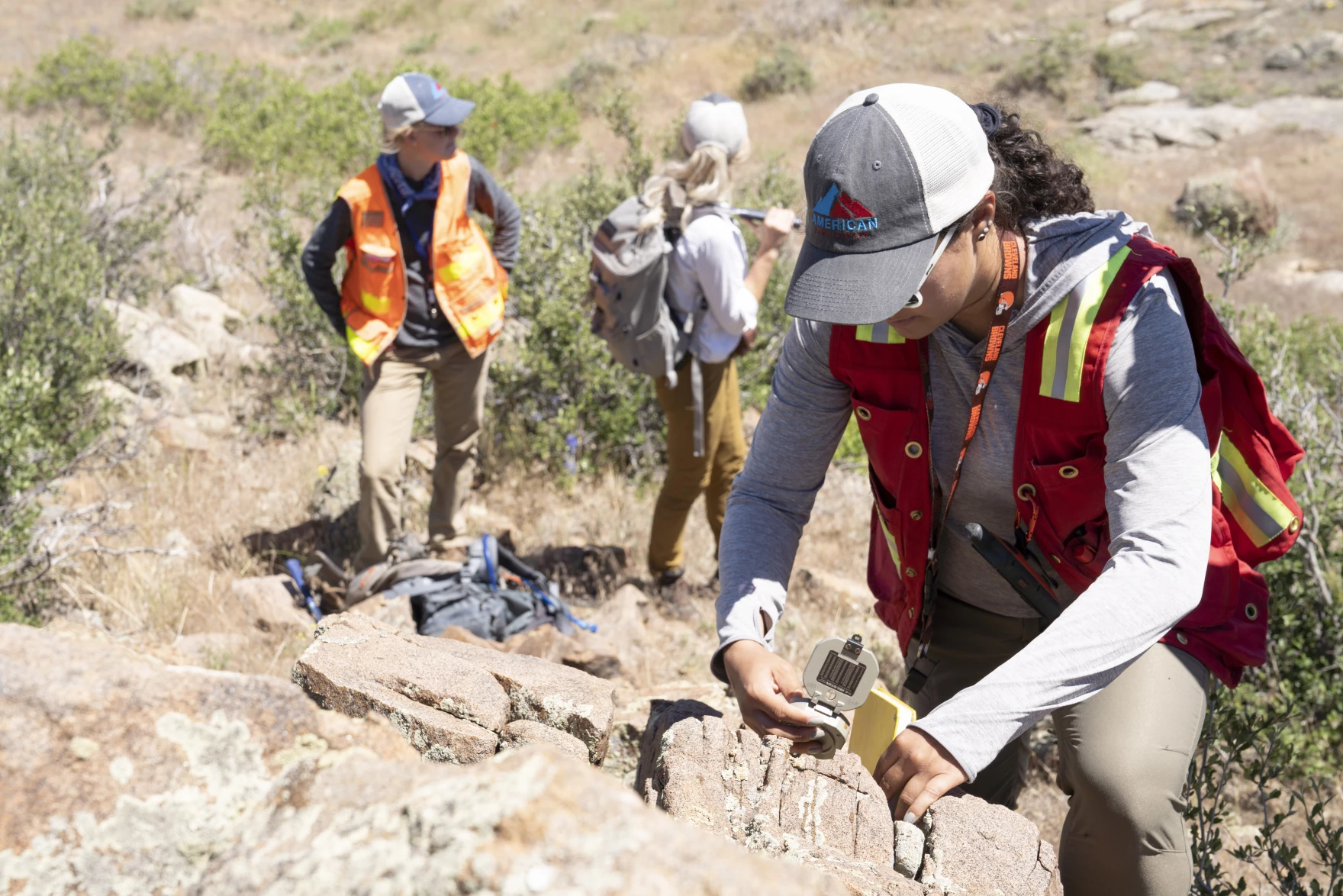 Professional mining geologists studying the Halleck Creek site,
which might be one of the largest rare earth deposits in the world.
Halleck Creek Project Early Sampling by American Rare Earths: YouTube Announcement
- Subsurface (core, 160 kg) and near-surface (surface, 15 kg) allanite-based ores from Halleck Creek, Wyoming were crushed to top size of
2-4 mm via laboratory jaw and roll crushers. - Bulk samples riffled into 1 kg representative sample lots for testing.
- Fine material (i.e., < 150 μm) separated via wet sieving before dry sieving samples via testing sieve shaker for 20 min for particle size-bysize
weight and elemental distribution analysis. - Grinding tests performed in laboratory rod mill (Ø206 mm x 263 mm) with steel rods (7 Ø13 mm x 232 mm, 8 Ø16 mm x 232 mm, 9 Ø19
mm x 232 mm) operated at 50 rpm with 65 %w/w slurry. - Materials pulverized via ring-and-puck mill prior to analysis.
- Allanite constituted 90% of total REEs and demonstrated high liberation at a coarse grain size (232 μm)
- Coarse-grain size indicates that a standard Wet High-Intensity Magnetic Separation (WHIMS) process might achieve high REE recovery and upgrading.
[Note: The general characteristics of the Halleck Creek samples are similar to those of the allanite at the Seward Penisula project site in Alaska (here).]
Resource Portal for I2M Clients, Associates, and Geoscientists
Managed & Built by I2M Consulting, LLC | © 2010-

Managed & Built by I2M Consulting, LLC | © 2010-